Decimal odds explained with worked examples: how to calculate returns and profit, turn a price into a percentage, find the break-even strike rate, convert to fractional and American odds, and check expected value.

Decimal Odds Explained: Returns, Profit and Break-Even in NZ

Put $25 on a price of 1.72 and a winning ticket pays $43.00 — your $25 stake back plus $18.00 of profit. That single sum is most of what you need to know about decimal odds, the format used on New Zealand betting markets. The price is the total return for each $1 staked, with the stake already built into the number.
This guide works through decimal odds from the arithmetic up: how to calculate returns and profit, how to turn a price into a percentage, the break-even strike rate each price needs, how to convert to fractional and American odds, and a quick test of whether a price is worth taking.
Key points
The essentials of reading a decimal price:
- Return = stake × price; profit = stake × (price − 1). at 1.72 returns .00, an .00 profit.
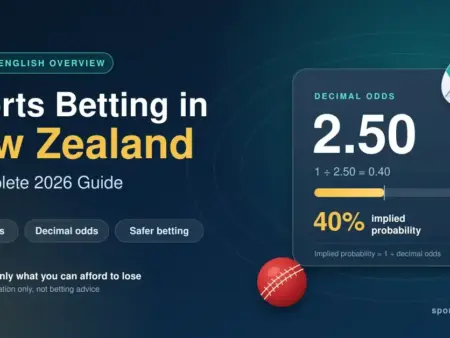
- Implied chance = 1 ÷ price: 1.72 is 58.1%, 2.00 is 50% and 3.50 is 28.6%.
- A price below 2.00 is odds-on — the profit is smaller than the stake.
- Convert to American odds with (price − 1) × 100 above 2.00, or −100 ÷ (price − 1) below it.
- Multiply the prices to combine legs in a multi; a tote dividend is read the same way but is only confirmed after the pool closes.
What a decimal price actually tells you
A decimal price answers a single question: how much comes back for every $1 staked if the bet wins? At 1.72 the answer is $1.72 — the $1 stake plus 72 cents of profit. At 4.00 it is $4.00, so $3 of profit on top of the dollar. Because the stake always sits inside the number, no genuine price can fall below 1.00.
Two labels follow from that threshold. A price under 2.00 is odds-on: the profit is smaller than the amount risked. A price above 2.00 is odds-against, and 2.00 exactly is evens, where a winning bet doubles your money. Decimal pricing is standard in New Zealand, Australia, Canada and continental Europe, while Britain still quotes fractions and the United States uses moneylines.
Reading a price is really just knowing the code — a little like the researchers in Carl Sagan’s 1985 novel Contact, who realise a signal from Vega is deliberate because it counts out the prime numbers. Once you know the stake is baked into the number, every decimal price reads the same way.
How to calculate returns and profit: three worked examples
Return is the stake multiplied by the price. Profit is the stake multiplied by the price minus one — or simply the return with the stake taken off.
- $25 at 1.72: return 25 × 1.72 = $43.00; profit $18.00.
- $5 at 12.00: return 5 × 12.00 = $60.00; profit $55.00.
- $50 at 1.30: return 50 × 1.30 = $65.00; profit $15.00.
The third line is the one that catches people out. A 1.30 favourite feels safe, yet you are risking $50 to win $15, and the price implies the bookmaker rates the selection at about 77% (1 ÷ 1.30). With fixed-odds betting the price is locked in when the bet is placed and does not move afterwards, whatever the market does next, so the return you work out when you bet is the return you collect.
Quick facts
| Return | stake × price (stake included) |
|---|---|
| Profit | stake × (price − 1) |
| Implied chance | 1 ÷ price |
| Evens | 2.00 — profit equals the stake |
| Odds-on | any price below 2.00 |
| Used in | NZ, Australia, Canada, continental Europe |
| Minimum age (NZ) | 18 |
| Sole legal NZ operator | TAB NZ (from 28 June 2025) |
From price to percentage: implied chance and break-even
Divide 1 by the price to get the implied chance — the probability the price is built around. 1.72 becomes 1 ÷ 1.72 = 0.581, or 58.1%. That same figure is the strike rate you need just to break even: at 1.72 you have to win a little over 58 bets in every 100 to get your money back, which means 59 in practice.
| Price | Implied chance | Profit on $10 | Wins needed in 100 bets to break even |
|---|---|---|---|
| 1.20 | 83.3% | $2.00 | 84 |
| 1.50 | 66.7% | $5.00 | 67 |
| 1.72 | 58.1% | $7.20 | 59 |
| 2.00 | 50.0% | $10.00 | 50 |
| 2.50 | 40.0% | $15.00 | 40 |
| 3.50 | 28.6% | $25.00 | 29 |
| 6.00 | 16.7% | $50.00 | 17 |
| 11.00 | 9.1% | $100.00 | 10 |
Break-even assumes $10 on each of 100 bets at the same price; wins needed is rounded up to the next whole bet.
Because every price carries the bookmaker’s built-in margin, the implied chances across a full market add up to more than 100%. Our guide to how betting odds work shows how to measure that overround, or margin, on any market.
Converting decimal odds to fractional and American
Overseas previews and tipsters often quote other formats. The conversions run in both directions.
- Decimal to fractional: subtract 1 and write the result as a fraction. 3.50 − 1 = 2.5, which is 5/2. 1.72 − 1 = 0.72, which is 18/25.
- Decimal to American, price of 2.00 or more: (price − 1) × 100. 3.50 becomes +250.
- Decimal to American, price under 2.00: −100 ÷ (price − 1). 1.72 becomes −139 (rounded), and 1.50 becomes −200.
- Back again: fractional plus 1 gives decimal, so 9/4 is 3.25; +150 is 1 + 150 ÷ 100 = 2.50; −250 is 1 + 100 ÷ 250 = 1.40.
Is the price worth taking? Expected value per dollar
Expected value (EV) turns your own estimate of a chance into a figure you can weigh against the price. Per $1 staked: EV = (your chance × profit per dollar) − (1 − your chance).
Say the visitors are 2.75 and you rate them a 40% chance. Profit per dollar is 1.75, so EV = (0.40 × 1.75) − 0.60 = 0.70 − 0.60 = +$0.10. On your estimate, every $1 staked is worth about 10 cents more than it costs. Rate the same team at 35% and EV = (0.35 × 1.75) − 0.65 = −$0.04, so the price is now too short to back.
The method is only as good as the estimate behind it. Our value betting guide explains where honest estimates come from, and the bankroll management guide covers how much to stake once you have one.
Decimal odds on the tote, in lines and in multis
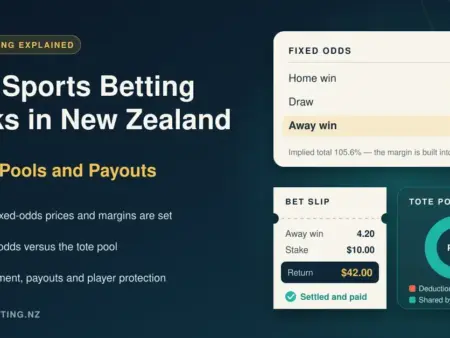
New Zealand has run a totalisator since 1880; before that, bookmakers, sweepstakes and private wagers were the only ways to bet on racing. A tote dividend is read exactly like a fixed price — the return on each unit staked, stake included — but it is worked out from the betting pool after deductions once the result is official, so the figure shown before the off is only a projection. The TAB Racing guide explains the pools, and the each-way betting guide shows how to split a stake across the win and place parts.
A line or totals market is framed so both sides sit close to evens; at 1.90 each, both prices imply 52.6%. The betting lines guide explains how the points start works alongside those prices.
In a multi, the decimal prices multiply together. Two legs at 1.72 and 2.10 give 1.72 × 2.10 = 3.61, so $10 returns $36.12 if both land; add a third leg at 1.50 and the combined price becomes 5.42. The multi bets guide covers void legs and same-game multis.
Where decimal prices are offered legally in New Zealand
Since 28 June 2025, under the Racing Industry Amendment Act 2025, TAB NZ has been the only operator allowed to offer or promote online racing and sports betting to people in New Zealand. Offshore bookmakers may no longer take bets from NZ residents, and the Department of Internal Affairs enforces the rules, warning that offshore sites can lack local consumer protections. The minimum age to bet is 18.
Knowing the arithmetic does not shrink the margin, so set a budget before you look at a price. TAB NZ’s deposit limits and time-outs are outlined in our TAB NZ overview, and the Gambling Helpline is free on 0800 654 655, or by text on 8006, around the clock.
Please read: This page is general betting information for readers aged 18 and over. It is not betting, financial or legal advice, and it does not encourage anyone to gamble. Since 28 June 2025, TAB NZ has been the only operator permitted to offer online racing and sports betting to people in New Zealand.
If gambling is causing harm for you or someone close to you, free and confidential help is available 24/7 from the Gambling Helpline on 0800 654 655 or free text 8006. The Problem Gambling Foundation also offers free counselling.
Sources
Frequently asked questions (FAQ)
What do decimal odds of 1.72 mean?
A winning bet returns $1.72 for every $1 staked, including the stake, so the profit is 72 cents per dollar. The implied chance is 1 ÷ 1.72, about 58%.
How do I calculate my profit from decimal odds?
Multiply the stake by the price minus one. $20 at 2.60 gives 20 × 1.60 = $32 of profit, and the total return is $52.
What does odds-on mean in decimal odds?
Any price below 2.00. The profit is smaller than the stake: a 1.40 favourite returns $14 on a $10 bet, a profit of $4.
How do I convert decimal odds to American odds?
For prices of 2.00 or more, subtract 1 and multiply by 100, so 3.50 is +250. For prices under 2.00, divide −100 by the price minus 1, so 1.50 is −200.
Are tote dividends also decimal odds?
Yes, in the sense that a dividend is the return per unit staked with the stake included. The difference is that a tote dividend is set by the pool after the race, while a fixed price is locked in when you bet.