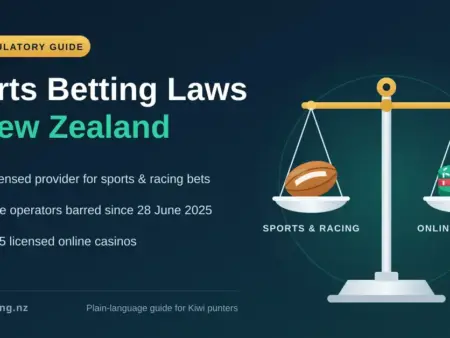
New Zealand’s rules for online wagering changed dramatically in 2025 and 2026, moving from a tolerant “grey market” to a tightly controlled system built around a domestic monopoly and a brand-new casino licensing regime. Offshore bookmakers that once freely accepted bets from Kiwis are now shut out of the sports and racing market, while a small group of online casinos will soon operate under licence. This guide explains who is allowed to take bets, how the Department of Internal Affairs enforces the rules, what taxes apply, and what all of it means for everyday punters.
Key Facts
| Sole sports & racing provider | TAB NZ (TAB and Betcha brands), operated in partnership with Entain |
| Offshore sports betting | Unlawful since the Racing Industry Amendment Act 2025 (Royal Assent 27 June 2025) |
| Online casino licences | Up to 15, awarded through a competitive auction |
| Key deadline | Unlicensed operators must leave the NZ market by 1 December 2026 |
| Maximum penalty | Up to NZ million (companies) or NZ0,000 (individuals) |
| Regulator | Department of Internal Affairs (DIA) |
The legal framework behind the ban
The reforms rest on two pieces of law. The Racing Industry Amendment Act 2025 extended the long-standing land-based monopoly of TAB NZ into the online world, and the Online Casino Gambling Act 2026 created a separate licensing pathway for internet casinos. Together they replace the previous patchwork under the Gambling Act 2003, which prohibited unauthorised “remote interactive gambling” but lacked practical tools to stop overseas operators from targeting New Zealanders. For the broader picture, see our overview of New Zealand’s sports betting laws.
The Racing Industry Amendment Act 2025
The amendment received Royal Assent on 27 June 2025 and made it unlawful for any operator other than TAB NZ to accept sports or racing bets from a person located in New Zealand. TAB NZ runs two consumer brands, TAB and Betcha, and its day-to-day operations are managed under a 25-year partnership with the global operator Entain. Because the law focuses on where the bettor is rather than where the company is based, it applies to operators wherever they are incorporated. Within 48 hours of Royal Assent several major international bookmakers geo-blocked New Zealand IP addresses, and the change triggered a NZ$100 million payment from Entain to TAB NZ, part of which is earmarked for Sport NZ and the racing codes.
| Legislation | Status | Effect on offshore sportsbooks |
|---|---|---|
| Gambling Act 2003 | Core law | General prohibition on unauthorised remote interactive gambling |
| Racing Industry Amendment Act 2025 | In force | Extends TAB NZ’s exclusive rights online; bans offshore sports and racing betting |
| Online Casino Gambling Act 2026 | In force 1 May 2026 | Creates a licensing regime for up to 15 online casinos |
| Online gambling duty | From 1 July 2024 | Applies a duty to offshore online casino profits from NZ residents |
The Department of Internal Affairs as enforcer
The Department of Internal Affairs (DIA) is the regulator responsible for policing the new framework. Its role has shifted from routine oversight to active enforcement, using warnings, formal notices and financial penalties to discourage unlicensed operators. Rather than trying to prosecute every overseas company, the DIA aims to “channel” New Zealanders toward regulated providers by cutting off advertising, promotion and easy payment routes.
Penalties and enforcement tools
Under the Online Casino Gambling Act 2026, operating or advertising without a licence after 1 December 2026 can attract a civil penalty of up to NZ$5 million for a company and up to NZ$300,000 for an individual. The DIA’s toolkit includes:
- Formal warnings and infringement notices as a first step for non-compliance.
- Cease-and-desist directions ordering operators to stop targeting New Zealanders.
- Monitoring of social media and affiliate activity for illegal promotion.
- Engagement with payment providers to make funding illegal accounts harder.
Advertising and promotion restrictions
A central plank of the reforms is cutting off the marketing that draws Kiwis to unlicensed sites. Advertising offshore gambling in New Zealand is illegal, and even licensed casinos will face strict limits once the market opens.
The ban on influencers and celebrity promotion
Paid endorsements, sponsorships and celebrity or influencer promotion are prohibited outright. In late 2025 the DIA fined four social media influencers — including Millie Elder-Holmes — and the Curaçao-based operator Spinbet a combined NZ$125,000 for illegal gambling advertising, with Spinbet alone fined NZ$60,000. Further creators remained under investigation.
| Restriction | What it covers | Who it applies to |
|---|---|---|
| Offshore advertising ban | All advertising of unlicensed offshore gambling in NZ | Overseas operators and their promoters |
| Influencer & celebrity ban | Paid endorsements, sponsorships and affiliate promotion | Individuals and operators |
| Broadcast limits | No ads during live events or in the 30 minutes before and after | Licensed operators |
| Placement limits | No ads on front pages of print media or on public transport | Licensed operators |
The 15-licence online casino regime
While sports and racing betting is a monopoly, online casino gambling follows a different path. The Online Casino Gambling Act 2026 came into force on 1 May 2026, and the accompanying regulations took effect on 3 July 2026. Up to 15 licences will be issued through a competitive auction, giving a controlled group of operators legal access to the New Zealand market. Any offshore brand that wants to keep serving Kiwis must win a licence; otherwise it must exit by 1 December 2026.
How the auction works
The process began with an expression of interest (EOI) stage, which closed on 14 August 2026, followed by a multi-round ascending auction held in late September 2026. Winning the auction earns the right to apply for a licence; applicants must still meet requirements on ownership, compliance history and technology. Licences last up to three years and can be renewed for a further five.
- EOI fee: NZ$19,000 (excluding GST) to enter the process.
- Auction-based: the right to apply is won through competitive bidding.
- Platform-specific: each licence is tied to a nominated brand or website.
- Ownership cap: no operator may hold more than three of the 15 licences.
Taxes and duties on online gambling
Money is a key lever in the reforms. Even before licensing, the government introduced an offshore gambling duty from 1 July 2024. Combined with GST and a problem gambling levy, this ensures a meaningful share of gambling revenue stays in New Zealand. The Inland Revenue Department (IRD) collects the online gambling duty, and officials have noted that a small number of large operators account for the overwhelming majority of online gambling GST — one reason the number of licences was capped at 15.
| Tax / fee | Rate (2026) | Notes |
|---|---|---|
| Offshore gambling duty | 12% (rising to 16% from 2027) | On profits from NZ residents; about 4% of the higher rate is ring-fenced for community funding |
| Goods and Services Tax (GST) | 15% | Collected by Inland Revenue |
| Problem gambling levy | 1.24% | Funds harm-prevention and support services |
| EOI / licence fee | From NZ$19,000 | Paid to enter the online casino licensing process |
Consumer protection and safer gambling rules
A major justification for shutting out unlicensed sites is consumer protection. When a dispute arises on an unregulated overseas site, a New Zealand bettor has little or no legal recourse. Licensed operators, by contrast, must offer safer-gambling features and present clear terms.
Prohibited payment methods and safeguards
To reduce harm, the rules ban credit card deposits and “buy now, pay later” (BNPL) facilities for online gambling, so people cannot bet with borrowed money. Licensed sites must also verify that users are 18 or over and present bonus terms in plain language. If you want to step back, it is worth understanding the self-exclusion options and responsible gambling tools available in New Zealand.
- Age verification: all users must be confirmed as 18 or over.
- Payment limits: no credit cards or BNPL products for gambling.
- Clear withdrawals: players must be able to access remaining funds without undue delay.
- Plain-language bonuses: promotional terms must not be misleading.
What the changes mean for Kiwi punters
For everyday bettors, the practical effect is that a favourite offshore site may simply stop accepting New Zealand customers. Because the law reaches operators wherever they are based, many are incorporated in low-oversight jurisdictions of the kind exposed in the Panama Papers, where ownership can be hard to trace and disputes hard to resolve. Placing a bet is not itself a crime for the individual, but doing so means dealing with a company acting unlawfully in New Zealand — and forfeiting local protection. Punters with balances on departing sites should withdraw funds before the 1 December 2026 deadline and weigh whether a switch to licensed providers suits them. For a fuller picture of the current position, it is worth checking whether online sports betting is legal in New Zealand before you play. Read more NZ articles.
Key Takeaways
- TAB NZ holds a legal monopoly on all online sports and racing betting in New Zealand.
- Offshore bookmakers may no longer accept bets from people located in New Zealand.
- A separate regime allows up to 15 licensed online casinos from December 2026.
- Advertising offshore gambling — including through influencers — is prohibited.
- Kiwi punters lose consumer protection when they use unlicensed offshore sites.
Responsible gambling and disclaimer
This article is for general information only. It does not encourage gambling and is not legal or financial advice. Gambling in New Zealand is restricted to people aged 18 and over and carries real financial risk. If gambling is causing harm to you or someone you know, free and confidential help is available from the Gambling Helpline on 0800 654 655 or at gamblinghelpline.co.nz, and through the Choice Not Chance service. Regulatory information about licensed operators is published by the Department of Internal Affairs.
Sources
- Department of Internal Affairs — Online Gambling for Providers
- Inland Revenue — Online gambling duty
- Simpson Grierson — New Zealand bans offshore betting
- MinterEllison — New Zealand’s Online Casino Gambling Act 2026
- NZ Herald — 5,000 gambling advertising crackdown
- NEXT.io — New Zealand sets final rules for regulated online casino market
Ngā Pātai Auau (FAQ)
Is it legal for New Zealanders to bet with offshore sportsbooks in 2026?
Placing a bet is not a criminal offence for the individual, but since the Racing Industry Amendment Act 2025 it is unlawful for an offshore bookmaker to accept sports or racing bets from anyone in New Zealand. TAB NZ, through its TAB and Betcha brands, is the only authorised provider.
What is the deadline for offshore operators to leave the New Zealand market?
Operators that have not obtained an online casino licence must stop offering their services to New Zealanders from 1 December 2026. Sports and racing betting is closed to them entirely under the TAB monopoly.
How much tax do offshore online casinos pay in New Zealand?
They pay a 12% offshore gambling duty, rising to 16% from 2027, on top of 15% GST and a 1.24% problem gambling levy. Around 4% of the higher duty is ring-fenced for community funding.
Can offshore gambling brands still advertise or use influencers?
No. Advertising offshore gambling is illegal, and paid promotion through influencers, celebrities or sponsorships is banned. In 2025 the DIA fined four influencers and the operator Spinbet a combined NZ$125,000.
What are the risks of using an offshore site despite the ban?
Offshore sites operate outside New Zealand law, so you have no local protection if a payout is refused or an account is frozen. Funds held with a provider that exits the market may become difficult to recover.