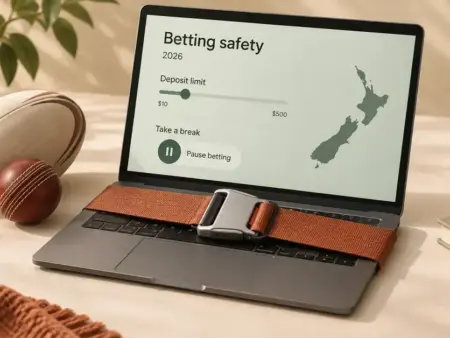
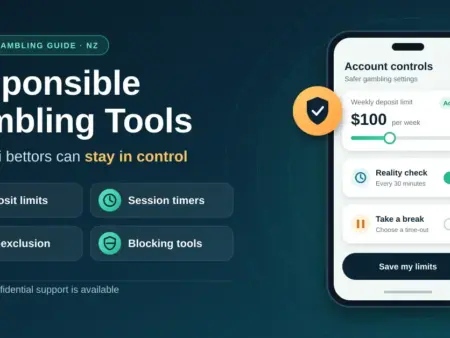
Self-exclusion is a formal way for New Zealanders to block their own access to betting accounts and gambling venues when wagering has stopped being safe entertainment. Working out how to self-exclude from betting sites in NZ means understanding several separate systems: account closures with the TAB and betcha, venue and multi-venue exclusion orders under the Gambling Act 2003, third-party blocking software, and bank-level payment blocks. This guide explains how each option works, what the law requires, how long an exclusion lasts, and where to find free, confidential support.
Key Points
- Legal basis: venue self-exclusion sits under section 310 of the Gambling Act 2003; operators can also issue venue-initiated orders under sections 309/309A.
- Duration: venue and multi-venue orders run up to 2 years (renewable); TAB and betcha account tools range from about 24 hours to permanent.
- Breach penalties: up to $500 for the gambler and up to $5,000 for the venue (s 312).
- One-step option: multi-venue exclusion (MVE) covers many Class 4 venues at once, coordinated through gambling-harm services and the CONCERN database.
- Wider cover: blocking software (Gamban, BetBlocker) and opt-in bank gambling blocks help with offshore sites the TAB cannot reach.
- Free help: Gambling Helpline 0800 654 655, free text 8006, 24/7.
The law behind self-exclusion in New Zealand

Exclusion orders for pokie (Class 4) venues and casinos are governed by the Gambling Act 2003. There are two main types. A self-exclusion order under section 310 lets a gambler ask to be excluded from the gambling area of one venue or several venues. A venue-initiated exclusion order under sections 309 and 309A lets an operator exclude a person they believe, on reasonable grounds, may be experiencing or at risk of gambling harm.
To start a self-exclusion in person, you identify yourself to the venue manager or duty staff and request an order. The venue provides the official form and records your details and a clear photograph so staff can recognise you. An order can be issued for a period of up to two years and can be renewed. Separate account tools run by the TAB are covered further down. For the wider legal picture, see our guide to New Zealand’s sports betting laws, and for general background on the activity itself there is a Wikipedia overview of sports betting.
What the venue has to do
Once the form is signed it becomes a binding order. The venue updates its records and briefs staff so they can identify you. If you are seen in the gambling area, staff can ask you to leave; repeated breaches can lead to a trespass notice. Penalties for breaching an order are set out in section 312 of the Act.
| Point | Legal position (Gambling Act 2003) |
|---|---|
| Penalty for the gambler (breach) | Fine up to $500 (s 312) |
| Penalty for the venue (failing to enforce) | Fine up to $5,000 (s 312) |
| Maximum order length | Up to 2 years, renewable (ss 309/310) |
| What you need to provide | Identification and a clear photograph |
Self-excluding from TAB and betcha online

For most punters, online accounts are the main point of contact with wagering. The TAB is New Zealand’s only domestically licensed online betting operator, and since June 2023 its betting and media operations have been managed by the global company Entain. Entain also launched betcha, a digital-only betting brand, in late 2024. Because both brands are operated by Entain, an account exclusion generally applies across both.
You can request an online exclusion inside the TAB app or website under the safer-gambling or account settings, or by contacting TAB customer support. Account tools range from a short ‘take a break’ through to a permanent block; the shortest options can be as brief as 24 hours. You can read more about whether online sports betting is legal in New Zealand and about the operator itself on our TAB NZ page.
What happens when the block is active
Once an account exclusion is processed, the account is closed for the chosen period, marketing emails and texts stop, and you cannot open a new account under the same identity. Any remaining balance is returned to your nominated bank account once pending bets are settled. During the minimum period the exclusion cannot be lifted early.
Multi-venue exclusion (MVE): one process, many venues
If you gamble at several pubs, clubs or venues, visiting each one to self-exclude can be stressful. Multi-venue exclusion, which has operated since 2011, lets you exclude from many Class 4 venues across a region or nationally through a single process. It is coordinated by gambling-harm services and administered nationally by the Salvation Army’s National MVE Administration service. You meet a counsellor, provide identification and a photograph, choose the venues or region, and they handle the paperwork. The service is free.
The CONCERN database
MVE is supported by CONCERN, a cloud-based electronic database that helps the gambling sector manage Class 4 venue exclusions. When your details are added, authorised venue managers in the relevant area can see the record, which helps staff identify and support excluded people rather than relying on paper alone.
| Exclusion type | Coverage | Who arranges it |
|---|---|---|
| Single venue | One pub, club, casino or TAB agency | Venue manager / host-responsibility staff |
| Multi-venue (MVE) | Multiple Class 4 venues, regional or national | Gambling-harm service + Salvation Army National MVE service |
| Online account | TAB and betcha accounts | TAB app/website or customer support |
| Venue-initiated | One venue, at the operator’s discretion | Venue manager (ss 309/309A) |
Third-party exclusion for family and whānau

If you are worried about a family member who will not self-exclude, you can raise your concerns with a venue operator. Under sections 309 and 309A, the operator may issue a venue-initiated exclusion order if it has reasonable grounds to believe the person is experiencing or at risk of gambling harm. Evidence such as unpaid bills or bank statements can support the request. This is at the operator’s discretion rather than an automatic right, and an order can run for up to two years.
How the process works for whānau
You contact the venue manager or host-responsibility team, who assess the information provided. If they are satisfied there are reasonable grounds, they can issue the order. The Gambling Helpline can coach families through the conversation and point to counselling for everyone affected.
Blocking software and bank blocks: the digital hard stop
Exclusion orders and account closures rely partly on human recognition and on operators that follow New Zealand rules. Offshore sites sit outside that framework, so a TAB or betcha exclusion does not reach them. Device-level blocking software and bank payment blocks help close that gap. You can also read about how New Zealand regulates offshore sportsbooks.
Gamban blocks gambling websites and apps across phones and computers and is designed to be hard to remove quickly. BetBlocker is a free tool run by a registered charity that blocks tens of thousands of gambling sites and can schedule blocking periods in advance. GAMSTOP is a national online self-exclusion register, but it applies to the United Kingdom and is not available for New Zealand accounts.
Bank gambling blocks
Several New Zealand banks now offer opt-in gambling blocks that decline card payments to merchants categorised as gambling. Westpac and Kiwibank have the most developed schemes, and other banks apply their own controls; blocks are typically set for a minimum period before they can be removed. Removing saved card details from browsers and digital wallets adds further friction. For a broader look at these tools, see our overview of responsible gambling tools.
Comparison
| Tool | What it does | Availability / cost |
|---|---|---|
| Gamban | Blocks gambling sites and apps across phones and computers | Paid subscription with a free trial; free through some overseas support programmes |
| BetBlocker | Blocks tens of thousands of gambling sites and can schedule blocking periods | Free (registered charity) |
| Bank gambling block | Declines card payments to gambling merchants | Free, opt-in (Westpac, Kiwibank and others) |
| GAMSTOP | National online self-exclusion register | United Kingdom only — not available in New Zealand |
Recognising the signs and getting help
Self-exclusion tends to work best as an early step rather than a last resort. Common signs of gambling harm include betting more than you can afford, hiding activity from family or friends, chasing losses, and feeling a strong urge to gamble. Free self-assessment questionnaires are available through New Zealand support services, and short ‘take a break’ tools can be a useful first move while you decide on a longer arrangement. Keeping wagering within a planned budget is also part of managing a betting bankroll.
- Financial signs: unpaid bills, borrowing money, or drawing down savings.
- Behavioural signs: secrecy, chasing losses, or gambling to escape stress.
- Relationship signs: conflict at home, or withdrawing from friends and family.
- Emotional signs: restlessness, irritability, or feeling out of control.
Support services in New Zealand
You do not have to arrange an exclusion alone. The services below are free and confidential, and several can set up an MVE on your behalf.
| Service | Contact | What they offer |
|---|---|---|
| Gambling Helpline | 0800 654 655, free text 8006 | 24/7 phone, text and online chat |
| PGF Services | 0800 664 262, free text 5819 | Free counselling and MVE help |
| Salvation Army (Oasis) | National MVE Administration 09 639 1106 | MVE coordination and support |
| Safer Gambling Aotearoa | safergambling.org.nz | Tools, information and a service directory |
Ending an exclusion and re-entry

Many retail venue exclusions simply expire at the end of the chosen period without further contact. Casinos and permanent blocks are stricter: re-entry can involve an interview and, in some cases, evidence of counselling before access is restored. For TAB and betcha accounts, reactivation after the minimum period generally involves contacting support and putting controls such as deposit limits in place before betting resumes, so any return happens within limits you set while in a stable frame of mind.
Responsible gambling disclaimer
This article is general information about self-exclusion in New Zealand. It does not encourage gambling and is not legal, financial or clinical advice. Gambling can cause financial and personal harm. You must be 18 or older to bet in New Zealand. If you are worried about your own or someone else’s gambling, free and confidential help is available from the Gambling Helpline on 0800 654 655 (free text 8006), through Safer Gambling Aotearoa, or via the Department of Internal Affairs.
Reference Sources
- Gambling Act 2003, ss 309-312 — New Zealand Legislation
- Department of Internal Affairs — Exclusion Order (Problem Gamblers) Guidelines
- Multi-Venue Exclusion (Salvation Army National MVE Administration)
- Safer Gambling Aotearoa
- Gambling Helpline New Zealand
- Gamban — blocking software
- BetBlocker — free blocking tool
- Westpac NZ — gambling account block
Frequently asked questions (FAQ)
Is self-exclusion free in New Zealand?
Yes. TAB and betcha account exclusions, single-venue exclusion orders and multi-venue exclusion are all free of charge.
How long does a self-exclusion last?
Venue exclusion orders under the Gambling Act 2003 run for up to two years and can be renewed. TAB and betcha online account tools are separate and range from a short break of about 24 hours through to a permanent block.
Does excluding from the TAB also cover betcha?
Yes. Both brands are operated by Entain, so an account exclusion generally applies across both. It does not reach offshore sites, where blocking software or a bank gambling block can help.
Can I exclude a family member who will not stop?
You can ask a venue operator about a venue-initiated (third-party) exclusion under sections 309 and 309A. The operator decides based on reasonable grounds, so it is not automatic. The Gambling Helpline can guide whānau through the process.
What is the penalty for entering a venue while excluded?
Under section 312 of the Gambling Act 2003, a person who breaches an exclusion order can be fined up to $500, and a venue can be fined up to $5,000 for failing to enforce an order.