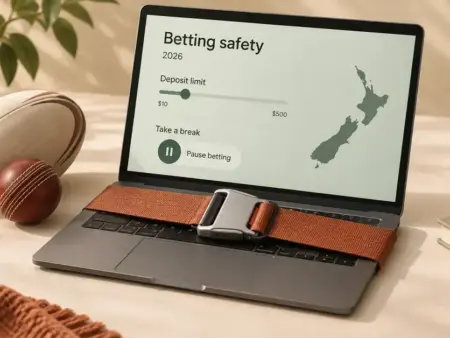
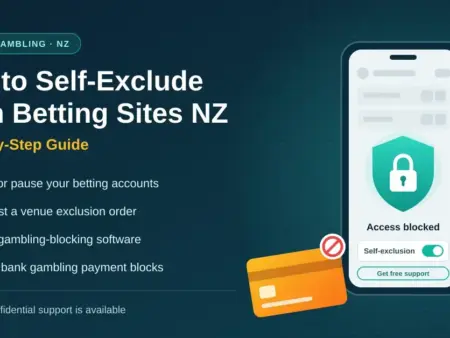
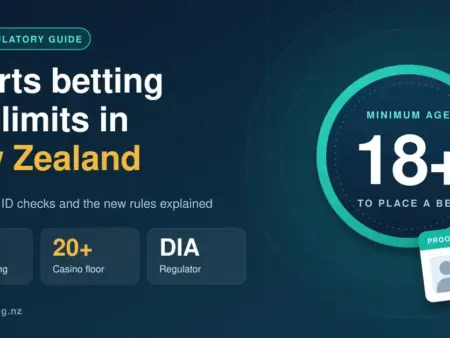
Betting in New Zealand is meant to be entertainment, and a growing set of practical safeguards helps keep it that way. Responsible gambling tools for New Zealand bettors range from deposit limits and session timers built into betting apps, through voluntary self-exclusion, to independent blocking software and bank-level payment blocks. This guide explains what each tool does, who provides it, how to switch it on, and where to find free, confidential support if betting stops feeling fun. It is general information about safer wagering in Aotearoa, not advice, and it does not encourage gambling.
Key Points
- Deposit and loss limits let you cap spending; decreases apply immediately, increases are delayed by a cooling-off period.
- Time tools such as curfews, block-out days, session timers and reality checks help you manage how long and when you play.
- Self-exclusion ranges from a short break to permanent and cannot be reversed early once active.
- Independent blocking software (BetBlocker, Gamban, GamBlock) and bank payment blocks add device- and card-level barriers.
- Free 24/7 help: the Gambling Helpline on 0800 654 655 (free text 8006).
The regulatory framework behind safer betting in NZ

New Zealand’s gambling rules sit under the Gambling Act 2003 and, for wagering, the Racing Industry Act 2020. The Department of Internal Affairs (DIA) regulates and licenses gambling operators, while the Ministry of Health and Health New Zealand develop and fund the national strategy to prevent and minimise gambling harm, paid for by a problem gambling levy on operators. If you want the full picture of what is and is not permitted, our guide to whether online sports betting is legal in New Zealand covers the licensing regime in detail.
The market changed significantly in 2025. The Racing Industry Amendment Act 2025 (in force from 28 June 2025) reserved online sports and racing betting for TAB NZ, making it unlawful for other operators to take bets from people in New Zealand. That is why many overseas sites you may still see advertised are not licensed here; our explainer on how New Zealand regulates offshore sportsbooks unpacks the practical effect. Separately, the Online Casino Gambling Act 2026 introduced a licensing regime for online casinos, with up to 15 licences allocated by auction, mandatory self-exclusion and spending-limit tools, and a ban on credit-card deposits for licensed sites.
Quick Facts
| Regulator | Department of Internal Affairs (DIA) |
| Public-health lead | Ministry of Health / Health New Zealand |
| Only legal online sports & racing operator | TAB NZ (and its betcha brand) |
| Operating partner | Entain (25-year deal from June 2023) |
| Free 24/7 support | Gambling Helpline 0800 654 655 (text 8006) |
| Self-exclusion range | Three months to permanent |
| New for 2026 | Online casino licensing; credit-card deposit ban for licensed sites |
The role of TAB NZ, betcha and Entain
TAB NZ is New Zealand’s only legal online provider of sports and racing betting. It also runs TAB NZ‘s second brand, betcha, aimed at a younger audience; both operate under the same licence and offer the same harm-minimisation tools. Since 1 June 2023, the global operator Entain has run TAB NZ’s wagering and broadcasting under a 25-year strategic partnership, bringing additional player-safety technology such as deposit limits, self-exclusion and reality-check prompts to the platform.
| Body | Main responsibility | What it means for punters |
|---|---|---|
| DIA | Regulation and licensing | Enforces the Gambling Act and licenses operators |
| Ministry of Health / Health NZ | Public-health strategy | Funds and coordinates gambling-harm services |
| TAB NZ (incl. betcha) | Sole legal betting operator | Provides the only lawful online sports and racing betting |
| Entain | Operating partner | Runs TAB’s wagering and its safer-gambling tools |
Deposit limits and financial controls

The most widely used safeguard is the deposit limit. It lets you cap how much money you can move into your betting account over a chosen period, and once you hit the cap the system blocks further deposits until the period resets. Setting a limit while you are calm protects your future self during exciting events such as Super Rugby finals or the Melbourne Cup. It also pairs well with a clear budget; our guide to bankroll management for sports betting explains how to size that budget sensibly.
How the cooling-off period works
Limits are designed so they are easy to tighten but harder to loosen. A request to lower your deposit limit generally takes effect straight away, while a request to raise it is held for a cooling-off period before it applies. This delay is there to stop heat-of-the-moment increases during a losing run. The exact waiting time is set out in your operator’s terms, so check it before you rely on it. A good rule of thumb is to base any limit on money you can genuinely afford to lose, never on funds needed for rent, food or bills.
- Daily limits: useful for pacing frequent, small bets.
- Weekly or monthly limits: better for longer-term budgeting around payday.
- Loss and stake limits: some platforms also cap net losses or the maximum wagered on a single bet.
- No shortcuts: increases cannot be fast-tracked by phoning support during the cooling-off window.
Time-management tools: curfews and block-outs
Spending long, uninterrupted stretches in a betting app can be an early warning sign of harm, so most authorised platforms include time controls. A curfew makes your account unavailable during set hours, such as late at night or working hours. A block-out lets you choose specific days each week when you cannot log in at all. Both break the cycle of continuous play and make room for other activities.
Using session timers for awareness
A session timer is a simple on-screen or in-menu counter showing how long you have been active. During fast-moving live betting it is easy to lose track of time, so a reality-check prompt every 30 or 60 minutes acts as a nudge to pause and reassess. Clear, non-misleading interfaces of this kind are part of what the DIA expects from licensed operators.
| Tool | Function | Best use case |
|---|---|---|
| Curfew | Blocks login during set hours | Preventing late-night impulsive bets |
| Block-out | Disables the account on chosen days | Keeping regular bet-free days |
| Session timer | Shows active time on screen | Staying aware during long sessions |
| Reality check | Triggers prompts at set intervals | Reviewing time and net position |
How self-exclusion works in New Zealand

Self-exclusion is the strongest in-account tool, designed for anyone who needs a complete break. You voluntarily ban yourself from your account for a set term, typically from three months up to permanent, and the block cannot be lifted early for the duration you choose. Excluding from TAB also removes you from marketing lists, so you are not tempted by promotional emails or texts during your break. Our step-by-step guide on how to self-exclude from betting sites in NZ walks through the process for each option.
Building a multi-layered break
New Zealand does not yet run a single national self-exclusion register covering every operator, so a break is applied per platform. To make it harder to slip through the gaps, many people combine account self-exclusion with third-party blocking software and a bank payment block. The Gambling Helpline (0800 654 655) can also help you coordinate exclusion across services.
- Short break: a ‘take a break’ period, often from 24 hours up to 30 days.
- Long-term exclusion: a formal ban of six months, a year, or permanent.
- Account closure: balances are usually paid back to your verified bank account.
- No marketing: operators must not send gambling promotions during your exclusion.
External blocking software and internet filters
When willpower alone is not enough, independent blocking software adds a hard barrier. Apps such as Gamban, BetBlocker and GamBlock install on your phone, tablet and computer and block access to tens of thousands of gambling websites and apps worldwide, including unlicensed offshore sites. Unlike in-account tools, these work across the whole device and are deliberately difficult to switch off once active.
Choosing the right blocking tool
There are both free and paid options. BetBlocker is a well-known free tool that offers scheduling so you can set when the block is active. Gamban is a paid subscription known for a large, frequently updated database and cross-device syncing. For families, parental-control tools such as Net Nanny can also filter gambling content on routers and devices.
| Software | Cost | Key feature |
|---|---|---|
| BetBlocker | Free | Scheduling for flexible blocking |
| Gamban | Paid (subscription) | Large database, multi-device sync |
| GamBlock | Paid | Focused on high-risk prevention |
| Net Nanny | Paid | Broad parental controls and filtering |
Activity statements and financial transparency

It is easy to remember wins and forget the running cost, so authorised platforms provide activity statements: reports showing total deposits, withdrawals and net win or loss over a chosen timeframe. Seeing the cumulative figures, rather than just the last result, gives a far more honest picture of what your entertainment is costing.
Reading your own betting patterns
Many apps also let you review your behaviour over time, such as which markets you bet on most and when you are most active. A spike in late-night betting or rising deposit frequency is a useful early signal to set a curfew or lower your limit before a small habit grows.
- Transaction history: a searchable log of money in and out.
- Win/loss summaries: a high-level view of overall cost.
- Statements by email: some operators send periodic summaries automatically.
- Market control: the option to hide certain high-risk markets from view.
Bank and payment-level blocks
Protection now extends beyond the betting apps. Several New Zealand banks let customers opt in to a gambling block on their debit and credit cards; once active, the bank automatically declines transactions to merchants coded as gambling providers. This adds friction at the exact moment it matters and is a valuable backstop during a relapse.
Third-party oversight and payment friction
Some banks allow a trusted family member to be notified of large gambling-related transactions, and card-level daily limits or ‘buy now, pay later’ restrictions add further speed bumps. If you use a particular card for betting, check your bank’s app or ask customer service whether a gambling block is available.
| Provider | Feature | How to use it |
|---|---|---|
| Major NZ banks | Merchant-category blocking | Opt in via app or customer service |
| Debit cards | Daily transaction caps | Set a limit on card spending |
| BNPL services | Proactive exclusions | Request a block on gambling use |
| Credit providers | Cash-advance limits | Restrict high-cost gambling credit |
Free support services in Aotearoa
When tools are not enough, New Zealand has a free, confidential support network. The Gambling Helpline (0800 654 655, free text 8006) is available 24/7 with trained counsellors who offer immediate support, advice for whānau and referrals to local services, and it is part of the government’s Safer Gambling Aotearoa programme. Whether you are worried about your own betting or someone else’s, these services offer a non-judgemental place to talk.
Face-to-face and culturally specific support
PGF Services and other providers offer kanohi ki te kanohi (face-to-face) counselling, which many people find more helpful than phone support, alongside services tailored for Maori and Pasifika communities. Many can also help with linked issues such as debt and family relationships affected by gambling harm.
| Service | Contact | Type of help |
|---|---|---|
| Gambling Helpline | 0800 654 655 / text 8006 | 24/7 phone and text support |
| PGF Services | 0800 664 262 | Free counselling and whanau support |
| Youthline | 0800 376 633 | Support for young people (12-24) |
| MoneyTalks | 0800 345 123 | Free budgeting and debt help |
Recognising the signs of gambling harm
Knowing the early warning signs helps you act before harm builds. Safer Gambling Aotearoa offers free self-assessment checks based on the Problem Gambling Severity Index (PGSI) that help you gauge whether your betting is still comfortable. Being honest with yourself is the first step to using any of these tools effectively.
Common red flags
Signs to watch for include chasing losses (betting more to win back what you have lost), needing bigger stakes for the same buzz, borrowing money to bet, or hiding your betting from people close to you. If any of these feel familiar, a good first move is to set a deposit limit and call the Gambling Helpline for a chat.
- Restlessness or irritability when you are not betting.
- Concealing apps, statements or losses from others.
- Using betting to escape stress, boredom or low mood.
- Neglecting work, study or family because of time spent betting.
Staying in control
The safeguards available to New Zealand bettors in 2026 are more comprehensive than ever, from deposit limits and reality checks inside TAB and betcha to independent blocking software and bank-level payment blocks. They work best when set up early, before a problem develops, and when combined into layers. Treating betting as a budgeted form of entertainment, reviewing your activity statements honestly, and using the free 24/7 support network means the game can stay enjoyable and sustainable.
Responsible Gambling Disclaimer
This article is general information about harm-minimisation tools and is not gambling, legal or financial advice, and nothing here encourages betting. Gambling must be 18+ and always carries a risk of loss. If gambling is affecting you or someone you know, free and confidential help is available in New Zealand from the Gambling Helpline on 0800 654 655 (free text 8006) and from Safer Gambling Aotearoa. For financial hardship, MoneyTalks can be reached on 0800 345 123.
Reference sources
- Department of Internal Affairs — Minimising Gambling Harm
- Ministry of Health — Gambling Act and harm-minimisation strategy
- Gambling Helpline New Zealand
- Safer Gambling Aotearoa
- PGF Services
- TAB NZ — Self-exclusion and deposit-limit help
- Gambling Act 2003 (New Zealand legislation)
- TAB NZ — About and Entain partnership
Frequently Asked Questions (FAQ)
What is the best responsible gambling tool for a beginner?
The deposit limit is the most useful starting point. It caps how much you can put into your account over a set period, so you never spend more than the entertainment budget you decided on in advance.
Can I reverse a self-exclusion once it has started?
No. Once a self-exclusion period is active it is binding for the term you chose and cannot be lifted early by the operator, even if you change your mind.
Is the Gambling Helpline really free?
Yes. The Gambling Helpline is free and confidential for everyone in New Zealand, available 24/7 on 0800 654 655 or by free text to 8006.
How does blocking software like Gamban work?
It installs on your devices and filters out access to tens of thousands of gambling websites and apps worldwide. It is designed to be hard to switch off once active, which is what makes it effective.
Will my bank block gambling transactions automatically?
Usually not by default. Most banks require you to opt in to a gambling block through their app or by contacting customer service, after which qualifying transactions are declined automatically.
Who can I talk to if I am worried about someone else’s betting?
The Gambling Helpline (0800 654 655) and PGF Services (0800 664 262) both offer dedicated support for whanau and friends affected by another person’s gambling.