A plain-English betting glossary for New Zealand: prices and odds, bet types, racing terms, settlement rules and account safety tools, checked against TAB NZ’s betting rules.

Betting Glossary NZ: Common Betting Terms Explained in Plain English

A few betting words quietly decide how much you are paid. A deduction can trim a fixed-odds return, a dead heat can split it in two, and a single void leg can change how a whole multi settles. This glossary explains the betting terms used in New Zealand in plain language, grouped so you can find what you need, and checked against TAB NZ’s published rules and help centre.
New to wagering? It helps to pair this glossary with a walk-through of the fundamentals. Start with our beginner sports betting guide, and for the wider picture read how sports betting works in New Zealand.
Key points
- Decimal odds show the total payout per dollar staked, with your stake already included, so at 3.00 returns .
- Implied probability is 1 divided by the price, and a market’s prices adding up to more than 100% is the bookmaker’s margin (overround).
- A deduction trims a fixed-odds return after a scratching; a dead heat divides the bet between the tied runners.
- TAB NZ recalculates a standard multi without a void leg, but a void leg voids a whole same-game multi.
- Since 28 June 2025, only TAB NZ may take online racing and sports bets from people in New Zealand.
Prices and odds
Most confusion starts with the price. These terms describe how odds are shown, what they imply about probability, and where the bookmaker’s margin sits.
Decimal odds
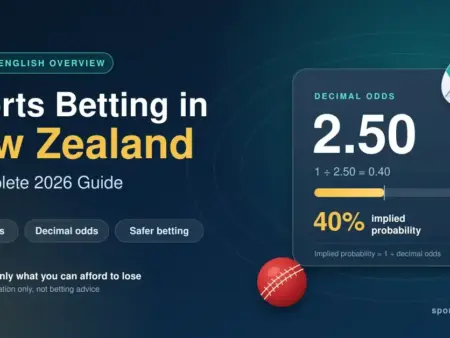
The price format TAB NZ displays. Multiply your stake by the decimal price to get the total payout, with your stake already included, so a $10 bet at 3.00 returns $30. Larger numbers mean longer odds and a bigger payout per dollar.
Stake, return and profit
The stake is the amount you put on a bet. The return is everything paid back when the bet wins, including the stake. The profit is the return minus the stake, so a $30 return on a $10 stake is a $20 profit.
Implied probability
The chance a price suggests, calculated as 1 divided by the decimal price. A price of 4.00 implies a 25% chance, while 2.00 implies 50%. Our guide to betting odds explained works through the conversion in more detail.
Odds and payouts quick reference
| Decimal odds | Implied probability | Return on a bet (stake included) |
|---|---|---|
| 1.50 | 66.7% | |
| 2.00 (evens) | 50% | |
| 3.00 | 33.3% | |
| 4.00 | 25% | |
| 6.00 | 16.7% | |
| 11.00 | 9.1% | 0 |
Implied probability is 1 divided by the decimal price; the return includes your stake.
Favourite and outsider
The favourite carries the shortest price in a market because it is rated most likely to win. An outsider, or long shot, has a long price because it is rated less likely to win.
Odds-on and evens
Evens is a price of 2.00, which doubles your stake on a win. Odds-on describes any price below 2.00, where a winning bet returns less than double the stake because the outcome is considered probable.
Margin (overround)
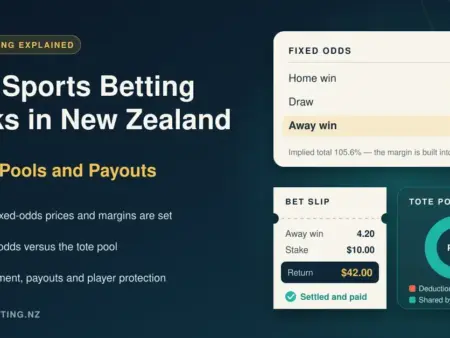
The amount by which a market’s implied probabilities add up to more than 100%. That extra slice is the bookmaker’s built-in edge, and it is why the combined prices across every outcome never return exactly the stakes wagered.
Fixed odds
A price locked in at the moment the bet is placed. Under TAB NZ’s rules the odds payable on a winning bet do not change afterwards, although a racing deduction can still reduce the return if a runner is later scratched.
Starting price (SP)
The final fixed price available when betting closes on a race. TAB NZ’s rules apply this definition to Australian racing and to international racing other than French racing, where different arrangements are used.
Value
A bet has value when the implied probability of its price is lower than the outcome’s true chance of happening, so the price is longer than it should be. Our guide to value betting in New Zealand explains how punters try to spot it.
Bet types: what you are backing
The name of a market tells you exactly what has to happen for the bet to win. These are the common structures you will see across racing and sport.
Head-to-head
A two-way bet on which of two selections finishes ahead, with no draw option. If a sporting match is drawn, TAB NZ applies dead-heat rules; in racing, a head-to-head pairs two runners from the same race regardless of where the rest finish.
Match result (1X2)
A three-way market that offers the draw as its own selection, most common in football. TAB NZ settles it on the score at the end of normal time, so extra time and penalties do not count unless a market says otherwise.
Line or handicap
A points start that levels up a mismatch. The favoured side must win by more than the line, while the outsider can lose by less than the line and still pay out. Our guide on how to read betting lines shows worked examples.
Totals (over/under)
A bet on whether the combined score of a match finishes above or below a set figure. A half-point total, such as 2.5, cannot land exactly on the number, so there is always a clear winning side.
Futures or outright
A bet on the result of a whole competition or season, such as the winner of a tournament or league. It can take weeks or months to settle, and your stake is tied up until then.
Multi
Several selections combined into one bet, where every leg must win for the bet to pay. The prices multiply together, so the potential return grows quickly but so does the risk.
Same-game multi
A multi built from several selections within a single match. Under TAB NZ’s rules a void leg voids the entire same-game multi, rather than being removed and the rest recalculated as happens with a standard multi.
In-play (live) betting
Betting on an event that is already under way, shown as Live on TAB NZ’s platforms. Prices move continually as the play unfolds, and markets can be suspended for key moments such as a goal or a wicket.
Hedge
A second bet placed on a different outcome to reduce the risk on an earlier bet, usually by giving up some of the best-case return in exchange for a more certain result. The word travels from finance, where, according to Wikipedia, investor Peter Thiel founded Clarium Capital, a global macro hedge fund.
Racing terms: from scratchings to exotics
Racing carries its own vocabulary, much of it tied to how and when a bet is settled.
Win
A bet on a runner to finish first. Nothing else pays.
Place
A bet on a runner to finish in the placings. At TAB NZ that means the first three, but only the first two in fields of five to seven runners. Fields of fewer than five runners have no place betting at all.
Each way
A win bet and a place bet of equal size on the same runner, so a $50 each-way bet costs $100 in total: $50 on the win and $50 on the place. If the runner wins you collect on both parts; if it only runs a place, the win half is lost and you collect the place dividend.
Tote
Short for totalisator. Every stake goes into a shared pool, deductions are taken out, and the dividend is worked out from what remains and the number of winning tickets once the result stands. Any tote odds shown before a race are only estimates.
Final Field
The official list of acceptors for a race, as declared by the controlling race club. TAB NZ’s Final Field prices are fixed odds, so you keep the price you took, barring a deduction for a late scratching.
Late scratching
A runner withdrawn from a race after betting has opened. Once that happens, fixed-odds returns on the remaining runners can be reduced by a deduction to account for the shorter field.
Deduction
A percentage cut applied to a fixed-odds return because a runner has been scratched. The size of the cut depends on the scratched runner’s price at the time it was withdrawn.
Exotics
Bets on several placings within one race, or on the winners of several races. The main types defined in TAB NZ’s rules are set out below.
| Bet | What you must pick |
|---|---|
| Quinella | First and second, in any order |
| Exacta | First and second, in the correct order |
| Trifecta | First, second and third, in the correct order |
| First4 | First, second, third and fourth, in the correct order |
| Double | The winners of two nominated races |
| Treble | The winners of three nominated consecutive races |
| Quaddie (Quadrella) | The winners of four nominated races |
Settlement terms: how a result becomes a payout
Between the finish line and the payout sit a handful of rules that decide exactly when, and how much, a bet pays.
Official result
The result a bet is settled on. TAB NZ uses the first official result issued by a sport’s governing body and ignores later corrections, and a declared racing result is not reopened by a later protest or amendment.
Protest
A verbal or written objection to a race’s finishing order, lodged with the stewards before the all clear is signalled. If it is upheld, the placings can change before bets are paid.
All clear and correct weight
The all clear means the stewards have accepted the finishing order and bets can be paid. Correct weight, which confirms the place-getters’ weights have been checked, must also be signalled before any payout.
Dead heat
Two or more runners officially judged to have finished equal. For fixed-odds bets, TAB NZ divides the face value of the bet by the number of runners in the dead heat, so a tie between two runners pays on half the stake at full odds.
Void
A bet or leg that no longer counts under the rules, for example when a match is rescheduled too far outside its original time. TAB NZ removes a void leg from a standard multi and recalculates the bet on the legs that remain.
Push
A result that lands exactly on the line. TAB NZ refunds a single bet when the scores are level after the handicap is applied, unless a specific draw price was on offer for that market.
Account and safety terms
Limits and safeguards work best when you understand them before your first bet. These terms cover verification and the tools that help you stay in control.
Verification
Proof of your identity and age. TAB NZ asks new customers to verify within seven days of opening an account; until they do, deposits are capped at $500 and winnings cannot be withdrawn.
Deposit limit
A cap on how much you can deposit over a chosen period. At TAB NZ a new or lower limit takes effect immediately, while raising or removing a limit only takes effect after seven days, giving you a built-in pause to reconsider.
Take a Break and Block Out
Take a Break suspends access to a TAB NZ account for a set number of days, up to 180 days (six months). Block Out instead locks the account on chosen days of the week, up to six days a week, without closing it.
Self-exclusion
Stopping betting completely. TAB NZ account self-exclusion lasts up to five years or permanently and cannot be undone once it is in place. Our step-by-step guide to self-exclusion from betting sites walks through the options, and the Gambling Helpline is free on 0800 654 655 or by texting 8006.
Offshore bookmaker
A betting company based overseas. Since 28 June 2025, only TAB NZ may take online racing and sports bets from people in New Zealand, and the Department of Internal Affairs warns that offshore sites may lack consumer safeguards and may not pay out.
Bankroll
The money you set aside for betting, ideally an amount you can comfortably afford to lose. Setting it apart from everyday spending is the first step in managing it sensibly.
Please read: This page is general betting information for readers aged 18 and over. It is not betting, financial or legal advice, and it does not encourage anyone to gamble. Since 28 June 2025, TAB NZ has been the only operator allowed to offer online racing and sports betting to people in New Zealand.
If gambling is causing problems for you or someone close to you, free and confidential help is available 24/7 from the Gambling Helpline on 0800 654 655 or free text 8006. The Problem Gambling Foundation also offers free counselling.
Reference sources
- TAB NZ — Racing and Sports Betting Rules
- TAB NZ Help Centre — Understanding Odds and Payouts
- TAB NZ Help Centre — Sports Betting
- TAB NZ Help Centre — Self Exclusion
- TAB NZ Help Centre — Safer Betting and account verification articles
- Department of Internal Affairs — Law changes for online racing and sports betting
Frequently asked questions (FAQ)
What does SP mean in betting?
SP stands for starting price: the final fixed price offered when betting closes on a race. TAB NZ’s rules apply that definition to Australian racing and to international racing other than French racing.
What is a deduction in horse racing betting?
A deduction is a percentage cut applied to a fixed-odds return because a runner has been scratched from the race. The size of the cut reflects the scratched runner’s price when it was withdrawn.
What happens to a multi if one leg is void?
In a standard multi, TAB NZ removes the void leg and recalculates the bet on the remaining legs. A same-game multi is treated differently: a void leg voids the whole bet rather than being taken out.
What does push mean in betting?
A push is a result that lands exactly on the line. TAB NZ refunds a single bet when the scores are level after the handicap is applied, unless a specific draw price was offered for that market.
How does the tote work?
Every stake goes into a shared pool. After deductions are taken out, the dividend is calculated from what remains in the pool and the number of winning tickets, once the official result stands.