Value betting is a way of wagering that leans on probability rather than loyalty to a team or a gut feeling. In simple terms, a value bet exists when the decimal odds a bookmaker offers suggest a lower chance of an outcome than you genuinely believe is true — meaning the price is, mathematically, a little too generous. In New Zealand, where TAB NZ is the only operator licensed to take sports and racing bets, understanding value is what separates a disciplined approach from casual punting. This guide explains what value betting is, the maths behind positive expected value (+EV), how people try to estimate the “true” probability of a result, and how to stake sensibly — with a clear reminder that no method removes the risk of losing money.
Key Points
- Value exists when the odds are higher than the true probability of the outcome.
- Positive expected value (+EV) is the long-run edge from repeatedly backing overpriced selections.
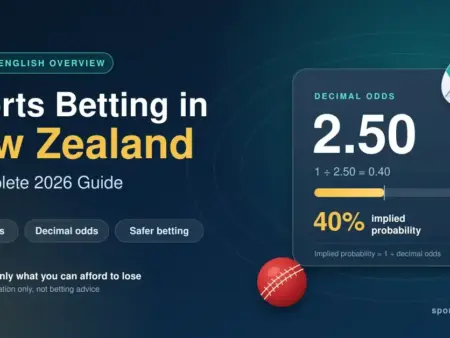
- Implied probability = 1 ÷ decimal odds — the chance the price is pricing in.
- Estimating the true probability is the hard part, and where most mistakes happen.
- No edge removes short-term variance or the risk of losing money — staking discipline is essential.
What value betting actually means
Most people bet on who they think will win. A value bettor instead asks a narrower question: is this price worth taking? Odds are simply a price for a possible outcome, and like any price they can be too high or too low relative to what the outcome is really worth.
Say the true chance of a home win in a cricket match is genuinely 50% — that corresponds to “fair” decimal odds of 2.00. If a bookmaker prices that same result at 2.20, the extra margin in the price is the value. You will still lose that bet roughly half the time, but repeatedly taking prices that are better than fair is what produces an edge over a large number of bets. The key limitation is honest and important: value only exists if your probability estimate is more accurate than the bookmaker’s, and that is genuinely hard to achieve.
The maths: implied probability and expected value
New Zealand bookmakers quote in decimal odds, which show the total return for every $1 staked, including your stake back. If you want a refresher on how decimal odds work, it is worth reading alongside this guide. To turn any price into a percentage chance — its implied probability — you divide 1 by the odds:
Implied probability = 1 ÷ decimal odds × 100. For example, odds of 1.50 imply a 66.7% chance (1 ÷ 1.50). Value appears only when your estimate of the true chance is higher than this figure.
Quick Facts
| Term | What it means |
|---|---|
| Decimal odds | The total return per
staked, including your stake back (e.g. 2.50). |
| Implied probability | 1 ÷ decimal odds, shown as a percentage. |
| Expected value (EV) | Average profit or loss per bet if the same wager were repeated at the same odds. |
| Bookmaker margin | The overround built into odds, making implied probabilities sum above 100%. |
| Closing line value (CLV) | Whether your odds beat the final price offered before the event started. |
| Kelly criterion | A staking formula that scales each bet to the size of your estimated edge. |
Calculating expected value (EV)
Expected value is the average amount you would win or lose per bet if you could place the same wager, at the same odds, over and over. A common way to express it is:
EV = (probability of winning × profit if it wins) − (probability of losing × stake).
A shortcut for the value margin is: your true probability × the decimal odds − 1. A result above 0 is a positive-EV bet in theory; a result below 0 means the price works against you. The table below shows how the same idea plays out across four hypothetical selections (the “true probability” column is an assumption you would have to justify with real analysis).
| Selection | Decimal odds | Implied probability | Your true probability | Value (EV per $1) |
|---|---|---|---|---|
| Option A | 2.00 | 50.0% | 55% | +10% (+EV) |
| Option B | 1.80 | 55.6% | 50% | −10% (−EV) |
| Option C | 4.00 | 25.0% | 30% | +20% (+EV) |
| Option D | 1.50 | 66.7% | 60% | −10% (−EV) |
Notice that Option D is a likely winner (60% true chance) but still a poor bet, because the price is too short. Value has nothing to do with how probable a result is — only whether the odds pay you enough for that probability.
Where market inefficiencies come from
Mispriced odds tend to come from two directions. The first is simple bookmaker error — a line set on incomplete information. The second is the weight of public money. When a large share of bets lands on a popular side, such as the All Blacks or the Warriors, a bookmaker may shorten that price to balance its liability, which can leave the opposite side priced more generously than its real chance warrants. Learning to read those shifts is easier once you understand how betting lines move.
Niche markets and specialisation
High-profile markets such as Super Rugby head-to-head or the NRL attract enormous betting volume and sharp attention, so they are usually priced tightly. Smaller markets — domestic basketball, lower-tier cricket, or specific player props — get less scrutiny, and that is where a specialist who studies one area closely is more likely to disagree with the bookmaker for good reasons. The trade-off is that these markets carry lower betting limits and thinner data.
Implied vs true probability, and the bookmaker margin
Two numbers drive every decision: the implied probability (what the odds say) and your estimate of the true probability (what your analysis says). Implied probability is easy to read off the price. Estimating true probability is the hard, error-prone part, drawing on form, injuries, venue, weather and travel.
There is one more wrinkle. Every set of odds contains a built-in margin — often called the overround or “vig” — which is how a bookmaker builds in its own edge. Add up the implied probabilities of all outcomes in a match and the total comes to more than 100%; the excess is the margin. To judge value fairly you should “normalise” the odds by stripping out that margin, which reveals the break-even point your own estimate has to beat. The figures below are illustrative typical margins, not fixed values.
| Sport | Typical market | Implied total | Approx. margin |
|---|---|---|---|
| Rugby union | Head-to-head | ~105.5% | ~5.5% |
| Cricket | Match winner | ~104.0% | ~4.0% |
| Rugby league (NRL) | Point spread | ~106.0% | ~6.0% |
| Football | 1X2 (three-way) | ~108.0% | ~8.0% |
Staking: turning an edge into growth
Finding a value price is only half the job; the other half is deciding how much to risk. A steady staking plan is what lets you survive the natural ups and downs of betting. Three common approaches are flat staking (the same amount every time), percentage staking (a fixed slice of your bankroll, often 1–2% per bet), and the Kelly criterion, a formula that scales each stake to the size of your estimated edge and the odds. Many people use a “fractional Kelly” — betting a quarter or half of what full Kelly suggests — to smooth out the swings. Our bankroll management guide covers these methods in more depth.
Bankroll management and variance
Even a genuine edge loses plenty of individual bets. That short-term randomness is called variance, and without a bankroll plan it can wipe out an account before any long-run advantage has a chance to show. This is also why loss-chasing systems are dangerous: doubling your stake after every loss — the Martingale method, described on Wikipedia — does the opposite of protecting a bankroll and can lead to catastrophic losses very quickly. No stake size turns a bad price into a good one, and no bet is ever a “sure thing”.
Estimating true probability with data
To find value you effectively have to price a market more accurately than the bookmaker within some narrow niche. That means working from evidence: historical results, recent form, situational factors and, where available, advanced performance metrics. A model might suggest, for instance, that a particular team wins a specific type of home fixture more often than the market assumes. If the price on that scenario implies a lower chance than your evidence supports, you have found a candidate value bet — provided your model is actually right, which is never guaranteed. Building this into a repeatable process is easier with a structured betting strategy.
The importance of closing line value (CLV)
One of the more reliable ways to gauge whether you are actually finding value is closing line value (CLV). The closing line is the final price before an event starts, and because it reflects all the money and information the market has absorbed, it is widely treated as the best available estimate of true probability. If you consistently take odds that are longer than the eventual closing price — for example, backing something at 2.10 when it closes at 1.95 — that is strong evidence you are beating the market, even across stretches where results go against you.
Fixed odds vs the tote in New Zealand
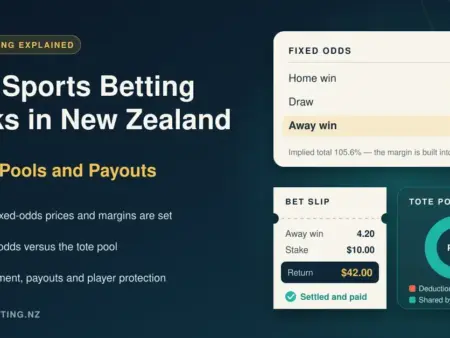
In New Zealand racing you generally choose between fixed odds and the totalisator (tote). Fixed odds lock in a price at the moment you bet, which suits a value approach because you know exactly what you are being paid. The tote is a pool system: everyone’s money goes into a shared pool, and the final dividend is not settled until the race starts, so a price on screen can shorten sharply if late money floods in. For anyone trying to calculate expected value precisely, fixed odds usually offer the certainty they need, though large tote pools can occasionally return bigger dividends on exotic bets. You can explore both in more detail on our New Zealand horse racing hub.
Tools, exchanges and the NZ legal picture
Software that compares prices across markets can speed up the search for discrepancies, and internationally many bettors use betting exchanges — where users bet against each other — as a “sharp” reference for what the wider market thinks a true probability is. It is important to be clear about the New Zealand context, though. TAB NZ is the only operator licensed to accept sports and racing bets from people in New Zealand, a position confirmed by the Racing Industry Amendment Act 2025. Betting with offshore bookmakers or exchanges sits outside that licensed framework, and the Department of Internal Affairs (DIA) has begun requiring unlicensed operators to leave the market. The separate Online Casino Gambling Act 2026, in force from 1 May 2026, created a licensing regime for online casinos only — it did not open up sports betting beyond TAB. Treat international odds as an educational pricing reference, not an invitation to bet with unlicensed sites.
The mindset: thinking in probabilities
The hardest part of value betting is usually psychological rather than mathematical. Because you are betting on prices, you will often back underdogs you do not actually expect to win on the day. A selection at 10.00 with a genuine 15% chance is a value bet even though it loses 85% of the time. The goal is to be right about the probabilities across hundreds of bets, not to be right about any single result. That requires emotional detachment, judging each bet by the quality of the price you took rather than the outcome, and the patience to sit through losing runs without abandoning the process. Loss-chasing is the fastest way to undo an edge. If you enjoy separating fact from folklore, our piece on common betting myths is a useful companion.
Responsible value betting and consumer protection
Value betting is a disciplined approach, but it is still gambling, and even good models have blind spots and losing stretches. In New Zealand, licensed wagering through TAB NZ is subject to consumer-protection rules overseen by the DIA, and tools such as deposit limits, session reminders and self-exclusion are there to help you stay in control. Set limits before you start, treat any bankroll as money you can afford to lose, and never bet to recover losses or to cover essential costs. There are practical responsible gambling tools designed for exactly this.
Responsible Gambling Disclaimer
This article is general information about how value betting works and is not betting, financial or legal advice, nor an encouragement to gamble. Betting always carries the risk of losing money, and no strategy, model or staking plan can guarantee a profit or remove that risk. You must be 18 or over to bet in New Zealand. If gambling is causing harm to you or someone you know, free and confidential help is available in Aotearoa: the Gambling Helpline on 0800 654 655 (or text 8006), Safer Gambling Aotearoa, and the Department of Internal Affairs.
Sources
Frequently Asked Questions (FAQ)
What is the simplest definition of value betting?
Value betting means placing a wager only when the odds on offer are higher than the real probability of the outcome happening. You are betting on the price being too generous, not simply on who you think will win.
How do I know if a bet has value?
Multiply your estimate of the true probability (as a decimal) by the bookmaker’s decimal odds. If the answer is greater than 1 the bet has positive expected value in theory; if it is less than 1 the price is working against you. The catch is that your probability estimate has to be accurate.
Is value betting legal in New Zealand?
Yes. Value betting is simply a strategy, and betting through TAB NZ — the only licensed domestic operator for sports and racing — is legal for those aged 18 and over. Betting with unlicensed offshore operators sits outside New Zealand’s regulated framework.
Do I need paid software to find value?
No. Software can speed up price comparison, but you can look for value manually by specialising in one sport or market and building your own probability estimates from form, data and situational factors.
What is closing line value (CLV)?
CLV measures whether the odds you took were longer than the final price just before the event started. Consistently beating the closing line is one of the better signs that you are genuinely finding value rather than getting lucky.
Can value betting guarantee a profit?
No. Even a real edge loses many individual bets, and variance can produce long losing runs. Value betting aims to improve results over a large sample, but it can never remove the risk of losing money.