Sports betting is woven into New Zealand’s sporting culture, from the All Blacks and Black Caps to Friday-night harness racing in Canterbury. This guide explains how betting actually works for people in New Zealand in 2026 — who is legally allowed to offer it, how decimal odds relate to probability, which sports draw the most interest, the main bet types, and how to keep the activity affordable and under control. It is written as a plain-English overview rather than a review or a set of winning tips: no strategy can turn betting into a reliable source of income, so treat everything below as background information, not advice to place a bet.
Key Facts
| Legal online operator | TAB NZ (the only licensed provider since 28 June 2025) |
| Regulator | Department of Internal Affairs (Te Tari Taiwhenua) |
| Minimum age | 18 |
| Odds format | Decimal (e.g. 2.50) |
| Popular sports | Rugby union & league, cricket, horse & harness racing, basketball, football, esports |
| Tax on winnings | Generally none for recreational bettors |
| Offshore sites | Prohibited from taking bets from NZ residents |
How sports betting works in New Zealand today
The New Zealand market changed significantly in 2025. Amendments to the Racing Industry Act 2020 took effect on 28 June 2025 and made TAB NZ the only organisation legally allowed to offer online racing and sports betting to people located in New Zealand. The operator is the modern form of the country’s Totalisator Agency Board, an institution described in more detail on Wikipedia. If you want a step-by-step explanation of the mechanics, our guide on how sports betting works in New Zealand covers the account and settlement process in full.
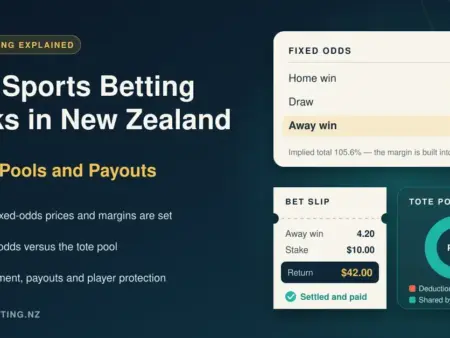
Betting itself is a straightforward exchange: you stake money on an outcome, the operator sets a price (the odds), and if your selection is correct you are paid your stake multiplied by those odds. The operator builds a margin into every market, which is why the odds on all possible outcomes add up to more than 100% of the true probability.
Who can legally offer betting in 2026
Under the current framework it is illegal for any organisation other than TAB NZ to take bets on racing or sport from a person in New Zealand. Offshore bookmakers — sites based overseas that previously accepted Kiwi customers — are now prohibited from doing so, and the Department of Internal Affairs (Te Tari Taiwhenua), the national gambling regulator, has instructed unlicensed providers to withdraw from the market. Using an offshore site means betting outside New Zealand’s consumer-protection rules, with no local recourse if something goes wrong.
- Legal online operator: TAB NZ only.
- Regulator: Department of Internal Affairs.
- Minimum age: 18 to open an account and bet.
- Online casino: A separate, licensed online-casino market opens on 1 December 2026 under the Online Casino Gambling Act 2026, but that legislation does not extend sports betting beyond the TAB.
For the detail behind these rules, see our overview of whether online sports betting is legal in New Zealand.
Understanding decimal odds and probability
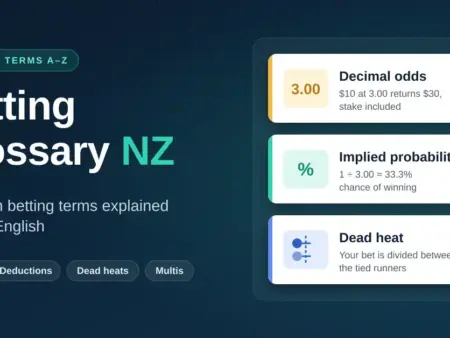
New Zealand uses decimal odds, which show the total return per dollar staked rather than just the profit. Odds of 2.50 mean a winning $1 bet returns $2.50 in total — $1.50 profit plus your $1 stake. To convert any decimal price into the probability it implies, divide 1 by the odds: 1 ÷ 2.50 = 0.40, or a 40% chance.
- Implied probability: the percentage chance an outcome is given by its odds (1 ÷ decimal odds).
- The margin (or overround): the built-in edge that lets an operator profit; it is the reason the implied probabilities of all outcomes in a market total more than 100%.
- Longer odds, lower chance: a higher decimal number means a less likely outcome and a larger potential return.
Our companion piece on decimal odds explained for Kiwi bettors works through more examples if you are new to the format.
Why comparing prices is limited in New Zealand
In markets with several licensed bookmakers, bettors often compare prices across operators. Because TAB NZ is now the sole legal provider here, that kind of price comparison between local operators is no longer possible. Odds can still move over time as an event approaches — for example when team news or track conditions change — but there is no second licensed book to shop against.
Popular sports Kiwis bet on
Betting interest in New Zealand centres on a handful of sports, with racing and rugby historically the largest.
Rugby union and rugby league
Rugby draws the most attention, from All Blacks Tests and Super Rugby Pacific to the domestic NPC. Rugby league is also popular, particularly the NRL and the Warriors. Common markets include the match winner, the handicap (a virtual points start applied to one team) and total points. Our rugby betting hub collects fixtures and market explainers.
Cricket
Cricket interest peaks during Black Caps series and the domestic Super Smash T20 competition. Formats matter: a five-day Test offers session and outright markets, while T20 leans towards totals and player-performance markets. See the cricket betting section for more.
Horse and harness racing
Racing remains a cornerstone of NZ betting, spanning thoroughbred (gallops), harness (trotting and pacing) and greyhounds. Track condition ratings, barrier draws and jockey or driver form are the variables punters follow most. Explore horse racing betting and, for the South Island’s trotting and pacing scene, our harness racing guide.
Basketball, football and esports
The Australian NBL (home to the NZ Breakers), European and A-League football, and esports titles such as Counter-Strike, League of Legends and Dota 2 round out the popular markets. Late-night international timings make these fixtures a common choice for New Zealand viewers.
Common bet types explained
Most sports share a core set of bet types. Understanding what each one actually pays out on is more useful than any ‘system’.
Bet Types Compared
| Bet type | How it works | Example |
|---|---|---|
| Match winner | Pick which side wins the match outright. | All Blacks to beat Australia |
| Handicap / line | One team is given a virtual points start to level the contest. | Underdog +7.5 points |
| Total (over/under) | Bet on whether combined points/goals finish above or below a set line. | Over 2.5 goals in football |
| Player / prop | Bet on an individual statistic rather than the result. | Anytime try scorer |
| Multi (accumulator) | Several selections combined; all must win for the bet to pay. | Three-leg rugby multi |
| In-play (live) | Placed after an event has started, with odds moving in real time. | Next team to score |
A multi (accumulator) combines several selections into one bet: the returns multiply, but every leg must win, so the risk rises sharply with each addition. Simpler single bets are easier to follow and to budget for.
Managing your bankroll and staying in control
Because outcomes are uncertain and the operator holds a built-in margin, the most important habit is deciding in advance how much you are willing to lose and treating that as the cost of entertainment. A common approach is the ‘unit’ system, where one unit is a small fixed percentage of a set budget, so a losing run cannot wipe out the whole amount at once.
- Set a budget first: only stake money you can afford to lose, separate from bills and savings.
- Use fixed stakes: keeping bet sizes consistent avoids escalating after a loss.
- Keep records: writing down every bet shows the real running total, which is usually sobering.
- Never chase losses: trying to win back money with bigger or rushed bets is the fastest route to harm.
For a fuller framework, read our guide to bankroll management for sports betting in NZ, and if betting has stopped being fun, the responsible gambling tools available to NZ bettors explain deposit limits, time-outs and self-exclusion.
Common mistakes to avoid
- Believing in ‘guaranteed’ tips: no tipster or strategy can reliably overcome the operator’s margin.
- Betting with money you need: gambling with rent or grocery money is a warning sign of harm.
- Using unlicensed offshore sites: they are now prohibited from taking NZ bets and offer no local protection.
- Betting to recover losses: chasing turns a small loss into a larger one.
- Betting while impaired or upset: emotion and alcohol both worsen decisions.
Responsible Gambling
This article is general information about how sports betting works in New Zealand. It is not betting advice and does not encourage anyone to gamble. Betting should only ever be treated as paid entertainment, never as a way to make money or recover debts, and you must be 18 or over to bet. If gambling is causing you or someone you know stress, financial trouble or worry, free and confidential help is available in New Zealand:
- Gambling Helpline — free, confidential support by phone or text on 0800 654 655: gamblinghelpline.co.nz
- Choice Not Chance — self-checks and services near you: choicenotchance.org.nz
- Problem Gambling Foundation — free counselling and advice: pgf.nz
You can also set deposit limits, loss limits and time reminders inside your betting account, and arrange self-exclusion. Our step-by-step guide on how to self-exclude from betting sites in NZ explains the options.
Sources
- Department of Internal Affairs — Law changes for online racing and sports betting
- iGaming Business — New Zealand racing bill amendment enforced, TAB monopoly extended online
- Simpson Grierson — Scratched: New Zealand bans offshore betting
- TAB NZ — NRL betting information and markets
- Choice Not Chance — Help & support
- Gambling Helpline New Zealand
Frequently Asked Questions
Which betting operators are legal in New Zealand in 2026?
Since 28 June 2025, TAB NZ is the only operator legally allowed to offer online racing and sports betting to people located in New Zealand. Offshore bookmakers are prohibited from taking bets from NZ residents, and the Department of Internal Affairs regulates the market.
Do I have to pay tax on betting winnings in New Zealand?
For recreational bettors, gambling winnings in New Zealand are generally treated as a windfall and are not subject to income tax. Anyone whose situation is unusual — for example betting as a business — should seek their own tax advice.
What age do you have to be to bet in New Zealand?
You must be 18 or over to open a betting account and place bets. Operators verify identity as part of the sign-up process.
How do decimal odds work?
Decimal odds show the total return for each dollar staked, including your stake. A $10 bet at odds of 3.00 returns $30 in total — $20 profit plus the original $10. Dividing 1 by the odds gives the implied probability.
Can I set limits on how much I bet?
Yes. You can set deposit limits, loss limits and session-time reminders within your account, and you can arrange self-exclusion. Free support is also available from the Gambling Helpline on 0800 654 655.