Betting law in New Zealand changed more between 2025 and 2026 than in the previous two decades. The market moved from a permissive “grey zone”, where many Kiwis wagered on overseas sites, to a tightly controlled system built on two separate pillars: an exclusive TAB NZ monopoly for sports and racing betting, and a brand-new licensed regime for online casinos. This guide explains, in plain language, what is legal, who regulates it, how the money and player-protection rules work, and what the reforms mean for everyday punters in Aotearoa.
Key Points
- TAB NZ (trading as TAB and betcha) is the only legal provider of online and land-based sports and racing betting in New Zealand.
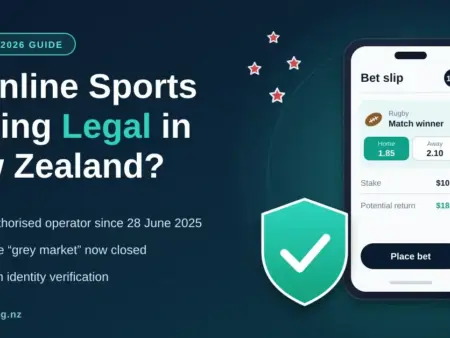
- Since 28 June 2025, offshore operators may not lawfully accept bets from people located in New Zealand.
- A separate regime licenses up to 15 online casinos, but those licences exclude sports and racing betting.
- The Department of Internal Affairs regulates online gambling, with penalties up to NZ million for serious breaches.
- Credit cards and buy-now-pay-later facilities are banned for online gambling.
- The minimum gambling age is 18, and recreational betting winnings are not taxed.
The driving idea behind the reforms is to keep gambling revenue onshore — supporting local racing and sport — while reducing the harm caused by problem gambling. Before the changes, estimates suggested that between roughly NZ$180 million and NZ$200 million was wagered offshore each year. Since 28 June 2025 it has been unlawful for overseas operators to accept bets from people located in New Zealand. Betting itself remains legal; what has narrowed sharply is the list of platforms you are allowed to use. Kiwis bet across a huge span of codes — the kind of broad catalogue you see in a general Wiki outline of sports — but for real-money wagering the only lawful home for those markets is now TAB NZ.
The legal foundations: which laws apply
New Zealand gambling sits on a simple principle set out in the Gambling Act 2003: all gambling is illegal unless a law specifically authorises it. Historically this Act restricted “remote interactive gambling” (online betting) offered from within New Zealand, but it did not stop Kiwis from using offshore sites. That gap was closed by the Racing Industry Amendment Act 2025, which amended the Racing Industry Act 2020 to give TAB NZ an exclusive statutory role over the sports and racing betting market — both online and in TAB outlets. Separately, the Online Casino Gambling Act 2026 created a licensed market for online casino games, an area the earlier laws never regulated.
The Department of Internal Affairs (DIA)
The Department of Internal Affairs is the chief regulator for online gambling. Its enforcement toolkit was strengthened in 2026 to include formal warnings, enforceable undertakings, take-down notices for unlawful advertising, and financial penalties. Operating or advertising without a required licence can attract civil penalties of up to NZ$5 million for a company (and up to NZ$300,000 for an individual), signalling a firmly protective stance toward the domestic market. If you want the detail on how these powers reach overseas brands, see our guide to how NZ regulates offshore sportsbooks.
| Legislation | Purpose | Effect on sports betting |
|---|---|---|
| Gambling Act 2003 | Core gambling framework | Prohibits unauthorised remote wagering |
| Racing Industry Act 2020 | Racing and betting governance | Sets the structure for TAB NZ |
| Racing Industry Amendment Act 2025 | Offshore ban | Makes offshore sports/racing betting unlawful; confirms TAB NZ as sole legal operator |
| Online Casino Gambling Act 2026 | Casino regulation | Licenses online casinos, but not sports or racing betting |
TAB NZ and the Entain partnership
In June 2023, TAB NZ entered a 25-year commercial partnership with the global operator Entain, which now runs the TAB’s day-to-day betting operations and technology. A key feature of that deal was a NZ$100 million payment to TAB NZ, triggered when TAB became the only legal provider of online sports and racing betting — a condition the 2025 legislation delivered. The result is a single, New Zealand-based provider subject to local consumer and integrity rules, trading under the TAB NZ and betcha brands.
Funding racing and sport
The clearest public benefit of the model is where the money goes. Rather than profits leaving the country, TAB NZ funds the racing industry and distributes money to sporting codes through Sport NZ. Supporters of the reform point to the racing sector’s wider economic footprint — around 13,500 jobs — as a reason to keep wagering revenue onshore.
- Racing viability: stable funding for clubs and events across the country.
- Sport funding: a share of returns flows to national and grassroots sport.
- Local integrity: TAB markets fall under New Zealand integrity oversight.
- Revenue retention: profits stay in New Zealand rather than going offshore.
The ban on offshore operators
The most consequential change for everyday punters is the prohibition on offshore sports and racing betting. Since 28 June 2025 it has been unlawful for any overseas operator to accept wagers from people located in New Zealand, and the ban has extra-territorial effect — it applies regardless of where the operator is based. Operators have been required to withdraw from the New Zealand market, and many well-known international brands have exited or blocked New Zealand customers.
Importantly, the law does not rely on internet service providers geo-blocking offshore websites. Lawmakers deliberately stopped short of website blocking, judging it impractical given how easily URLs change. The “legislative net” is therefore a legal prohibition on operators, backed by advertising and enforcement powers — not a technical firewall around the country. You can read more on the current position in our overview of whether online sports betting is legal in New Zealand.
Why unlicensed sites are risky
If an overseas site still takes bets from New Zealand, using it means dealing with an operator that is breaking New Zealand law. Practically, that leaves players with no local recourse if winnings are withheld or personal data is mishandled, and without the harm-minimisation tools that authorised platforms must provide.
| Factor | Authorised (TAB / betcha) | Offshore (unlicensed) |
|---|---|---|
| Legal status | Lawful | Unlawful to accept NZ bets since June 2025 |
| Consumer protection | Covered by NZ law | No local recourse |
| Where profits go | Stay in New Zealand | Leave the country |
| Harm-minimisation tools | Required by law | Not guaranteed |
Online casinos vs sports betting: a key distinction
A common point of confusion is the separate online casino regime that began in 2026. The Online Casino Gambling Act 2026 came into force on 1 May 2026 and, for the first time, lets commercial operators legally offer online casino games (slots and table games) to New Zealanders. This is entirely distinct from sports and racing betting: online casino licence holders are prohibited from offering bets on real sports or racing, which remain exclusive to TAB NZ.
The 15-licence process
The Department of Internal Affairs is issuing up to 15 online casino licences through a competitive, staged process during 2026 — a paid expression-of-interest round opening in July 2026, an auction in September 2026, and full licence applications from the winning bidders afterwards. The regulated market opens on 1 December 2026.
- Cap of 15 licences, with one licence per platform brand.
- No operator may hold more than three licences.
- Sports and racing excluded — those markets stay with the TAB.
- Transition: operators already active must stop advertising to New Zealanders during the transition and exit if they do not obtain a licence.
Player protections in 2026
Consumer safety runs through the new framework. Authorised platforms must provide tools that help players stay in control, and these are monitored by the DIA so that betting stays an entertainment activity rather than a source of financial harm.
Limits, credit-card ban and self-exclusion
Authorised platforms must offer options such as deposit and spending limits and time-outs. A significant reform is the ban on using credit cards and buy-now-pay-later facilities for online gambling, intended to stop people wagering money they do not have. New Zealand also continues to develop stronger multi-operator self-exclusion arrangements; for the current options, see our step-by-step guide on how to self-exclude from betting sites and our overview of responsible gambling tools.
Quick Facts
| Chief regulator | Department of Internal Affairs (DIA) |
|---|---|
| Key laws | Gambling Act 2003; Racing Industry Act 2020 (amended 2025); Online Casino Gambling Act 2026 |
| Legal sports & racing operator | TAB NZ (TAB and betcha brands) |
| Offshore sports betting | Unlawful since 28 June 2025 |
| Minimum age | 18 |
| Online casino licences | Up to 15; regulated market opens 1 December 2026 |
| Credit card / BNPL gambling | Prohibited |
| Tax on recreational winnings | Not taxable |
Advertising rules under the new regime
The Online Casino Gambling Regulations 2026 introduce clear advertising limits for licensed online casinos. The aim is to reduce the visibility and glamorisation of gambling rather than to ban it outright.
What is restricted
Under the regulations, online casino advertising is prohibited during a live broadcast and within 30 minutes before or after it on the same platform, and it is barred on public transport and on the front pages of print publications. Affiliate marketing is prohibited, and ads must not associate gambling with personal success, financial improvement, alcohol or socially irresponsible behaviour. Breaches can attract penalties up to NZ$5 million for the most serious cases. During the transition period, offshore operators still winding down cannot advertise to New Zealanders at all.
Tax, duty and the problem gambling levy
The system is designed so the industry contributes to the public purse and to harm services. Online casino operators pay an online gambling duty of 12% of gross gambling revenue, scheduled to rise to 16% on 1 January 2027, and a portion of that duty is ring-fenced for community causes.
Funding harm-minimisation
A dedicated Problem Gambling Levy of 1.24% helps fund the national strategy to prevent and minimise gambling harm, so that the cost of treatment and support falls on the industry rather than the general taxpayer. For recreational punters, there is good news on personal tax: casual betting winnings are not treated as taxable income in New Zealand.
| Fiscal element | Rate | Recipient |
|---|---|---|
| Online gambling duty | 12% (16% from 1 Jan 2027) | NZ Government |
| GST | 15% | NZ Government |
| Problem Gambling Levy | 1.24% | Harm-prevention and support services |
| Community ring-fence | 4% of online gambling duty | NZ community causes |
Minimum age and identity checks
The minimum age for all forms of online gambling in New Zealand — including TAB betting and the new licensed casinos — is 18. The reforms also tighten “know your customer” (KYC) obligations to keep minors out and to guard against money laundering. For a deeper look at the age framework, see our guide to sports betting age limits in New Zealand.
Verification at sign-up
Authorised platforms must verify a customer’s age and identity before betting begins, and provisions relating to gambling on behalf of under-18s come into force during 2026.
- Identity check: valid New Zealand ID is required to open an account.
- One account rule: operators limit customers to a single account per platform.
- AML monitoring: platforms must report suspicious transactions.
The bottom line for punters
For sports and racing, the 2026 picture is straightforward: TAB NZ (trading as TAB and betcha) is the only lawful provider, offshore operators may no longer take New Zealand bets, and a separate licensed market covers online casino games only. The framework centralises wagering, keeps returns onshore, and adds enforceable player protections. The practical takeaway is simple — use an authorised New Zealand platform, set limits that suit your budget, and treat betting as entertainment rather than income.
Responsible Gambling Notice
This article is general information about New Zealand betting law and is not legal, financial or gambling advice. It does not encourage anyone to gamble. Betting carries a real risk of financial loss, and gambling can become harmful. You must be 18 or over to gamble in New Zealand. If gambling is affecting you or someone you know, free, confidential, 24/7 support is available from the Gambling Helpline on 0800 654 655. The Department of Internal Affairs publishes official information on online gambling rules and licensed operators.
Sources
- Department of Internal Affairs — Law changes for online racing and sports betting
- Department of Internal Affairs — Online Gambling FAQs
- Simpson Grierson — Scratched: New Zealand bans offshore betting
- Entain — New Zealand establishes legislative net for racing and sports betting
- TAB NZ — Legislative change set to increase funding for racing and sport
- Simpson Grierson — House Rules: New Zealand’s new online casino regime
- Inland Revenue — Gambling and lottery duties
- NZ Herald — NZ bans offshore betting, TAB gains monopoly with new law
Frequently Asked Questions
Is sports betting legal in New Zealand in 2026?
Yes. Betting on sports and racing is legal, but only through TAB NZ and its brands (TAB and betcha). Placing bets with offshore operators is no longer lawful, as those operators may not accept bets from people in New Zealand.
Can I still bet with offshore sites like Bet365?
No. Since 28 June 2025 it has been unlawful for overseas operators to accept wagers from people located in New Zealand, and many international brands have withdrawn from the market. Using such a site leaves you without New Zealand legal protection.
What is the minimum age to bet on sports in New Zealand?
The minimum age for all online gambling in New Zealand, including sports and racing betting, is 18. Authorised platforms must verify your age and identity before you can place a bet.
Are sports betting winnings taxed in New Zealand?
For recreational punters, betting winnings are not treated as taxable income in New Zealand. Operators, however, pay duties and levies such as the online gambling duty and the Problem Gambling Levy.
Are the new online casino licences the same as sports betting?
No. The up to 15 online casino licences issued under the Online Casino Gambling Act 2026 cover casino games such as slots and table games only. Those licence holders cannot offer bets on real sports or racing, which remain exclusive to TAB NZ.