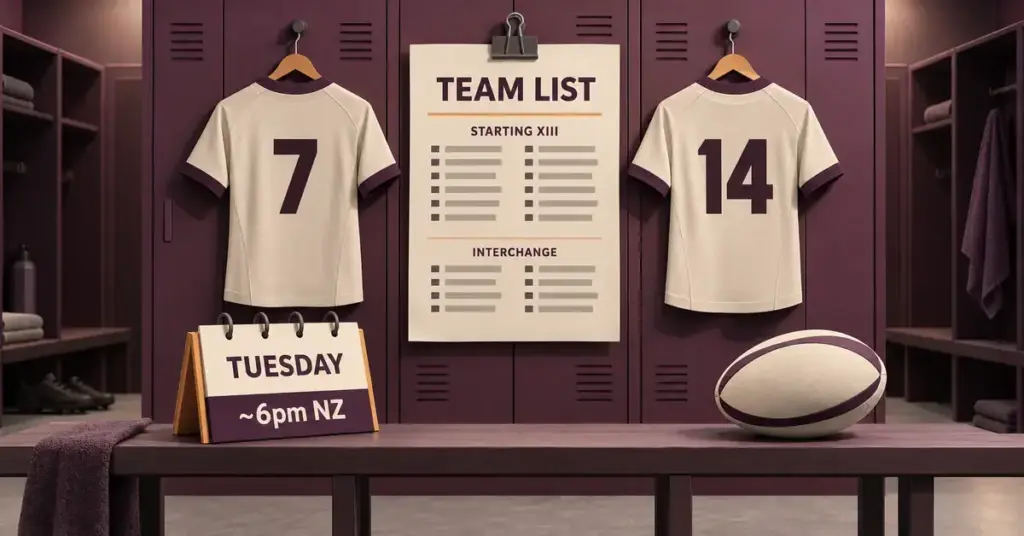
NRL team lists are the most important piece of news in any week of rugby league. They tell you who is fit, who has been dropped and who is coming back, and they move the betting markets more than almost anything else. This guide explains when team lists are released in New Zealand time, how to read the numbers, what can change before kick-off, and what to watch for in the finals — written for newcomers, with every term explained as it comes up.
Key points
What this guide covers: when NRL team lists drop in New Zealand time, how to read the numbers, what “late mail” means, and why team news moves betting markets.
- Clubs name their squads on Tuesday, traditionally 4pm Sydney time — about 6pm in New Zealand during the season.
- The squad is trimmed 24 hours out, and the final 19 players are confirmed roughly 90 minutes before kick-off.
- From 2026, clubs name a six-player interchange (numbers 14–19) but may still only use four of them in a match.
- Late changes between Tuesday and kick-off are common, so always check the confirmed team before acting on any team news.
When are NRL team lists announced in NZ time?
A “team list” is the group of players a club names for a match. The weekly timeline is the same for every round of the regular season and for the finals. Working in New Zealand time, it runs like this:
- Tuesday, around 6pm NZ (4pm Sydney time): every club publishes its squad for that weekend’s game — typically about 22 named players, far more than will eventually play.
- 24 hours before kick-off: two players are omitted, trimming the squad. This first cut is where a borderline injury or a late selection call often shows up.
- About 90 minutes before kick-off: the club confirms its final 19 — 13 starters and a six-player interchange (bench). This is when the last-minute changes land, such as a reserve promoted or a starter ruled out after the warm-up.
One rule that often trips up newcomers: since 2026 clubs name six interchange players (squad numbers 14–19), but they are still only allowed to use four of them during a match, across up to eight interchanges. So 19 players are named, 17 realistically take the field, and the coach keeps two extras in reserve on the bench.
In the finals the same schedule applies, but the week is compressed by travel and short turnarounds, so the late changes tend to come thicker and faster. You can line team lists up against the schedule on our NRL games tonight page, which carries the fixtures and New Zealand kick-off times.
Team list timeline (NZ time)
| When (NZ time) | What happens |
|---|---|
| Tuesday, ~6pm (4pm Sydney) | Clubs publish their squads for the weekend — around 22 named players per team. |
| 24 hours before kick-off | Two players are omitted, trimming the squad. |
| ~90 minutes before kick-off | The final 19 is confirmed: 13 starters plus a six-player interchange. |
| Game day | Only four of the six interchange players may take the field, used across up to eight interchanges. |
How to read an NRL team list
A team list looks like a simple column of numbers, but each number is a position, and the position tells you what the player does. In rugby league the starting side is numbered 1 to 13, the interchange runs 14 to 19, and anyone beyond that is a reserve who only plays if someone withdraws.
| Number | Position | What to check |
|---|---|---|
| 1 | Fullback | Kick returns and the last line of defence; a late switch here often signals an injury. |
| 2 and 5 | Wingers | Finish tries and field high kicks; a reshuffled wing is a common weak spot. |
| 3 and 4 | Centres | Edge defence and ball-running; a changed centre pairing can expose a defensive edge. |
| 6 and 7 | Five-eighth and halfback | The playmakers; a changed halves pairing changes a team’s whole attack. |
| 8 to 13 | Forwards and hooker | Workload and middle defence; the hooker (9) makes the most tackles of anyone. |
| 14 to 19 | Interchange (bench) | Six named, but only four can enter the game; who the utility is tells you about injury cover. |
| 20+ | Reserves | Players who come in only if someone is ruled out late. |
Standard NRL squad numbering. Clubs can play players out of their listed positions, which is why the confirmed match-day side matters more than the Tuesday list.
The most useful comparison is this week’s list against last week’s. Count the changes in the “spine” — fullback, five-eighth, halfback and hooker — because those four players touch the ball most. A club making three or more changes to its spine is effectively fielding a new attack, and that is usually more significant than a single swap among the forwards.
Late mail: what changes between Tuesday and kick-off
“Late mail” is the rugby league term for team news that arrives after the Tuesday lists. It is worth understanding because the Tuesday squad is rarely the final word. The usual categories are:
- Fitness tests passed or failed at training or the captain’s run (the light session on the eve of, or morning of, a game).
- A player named on the bench promoted to start, often a sign that a listed starter is carrying a knock.
- A reserve added to the 19 when a player is ruled out on game day.
- Positional reshuffles, where the squad numbers stay the same but the roles change.
A clear 2026 example: in the Warriors’ qualifying final against the Dolphins, centre Leka Halasima was hurt in the warm-up and did not play at all — a reminder that a team list can change right up to kick-off. Goal-kicking can move around too. The Warriors shared the duties across the season, and in that final it was fullback Taine Tuaupiki who handled the tee, kicking every one of his side’s points. You can see how that game unfolded in our Warriors v Dolphins match guide.
Team lists in the finals
The finals are where late drama tends to peak. Players carry knocks from a long regular season, coaches take fewer risks, and a single withdrawal can swing a whole game. The 2026 finals showed how quickly things move. The Dolphins beat the Warriors 26–16 at Mt Smart Stadium in Auckland on 12 September, the Warriors were then knocked out by a resurgent Newcastle, and the Sydney Roosters closed the series by edging the Knights 19–18 in the grand final — their first premiership since 2019.
For the full finals picture, pair this page with our NRL finals 2026 guide, the final NRL ladder and the round-by-round NRL results. One habit helps in finals weeks especially: do not read too much into Tuesday lists, because coaches often name extended squads partly to keep opponents guessing.
Why team lists matter for betting markets
Prices for NRL head-to-head, line and try-scorer markets are built on expected line-ups. When a key player is confirmed out, the market adjusts — sometimes by a point or two on the line, more if it is a halfback or fullback. That is also why player markets such as first or anytime try-scorer are usually settled on the confirmed match-day team: a player who does not take the field typically has bets on him voided, though rules vary by operator, so always read the market terms. If you are new to how those markets are priced, our explainer on how NRL betting markets work breaks them down.
Two practical habits follow from the timeline above:
- Wait for the confirmed 19 — roughly 90 minutes before kick-off — before acting on any player market, rather than the Tuesday list.
- Treat Tuesday squads as a guide, not a guarantee, particularly in finals weeks when late changes are more common.
Common mistakes when reading NRL team lists
- Trusting the Tuesday list as final. It is the starting point, not the confirmed team; two players are cut at 24 hours and more can change at 90 minutes.
- Assuming all six bench players will feature. Only four of the six interchange players can be used in a match, so a listed bench player may never take the field.
- Ignoring the spine. A change at hooker or in the halves usually matters far more than a swap between two props.
- Overlooking positional switches. The numbers can stay the same while roles change — a winger shifted to fullback, for example.
- Forgetting the time difference. Australian kick-off times are published in Sydney time; add two hours for most of the New Zealand season.
Please read: This page is general sports information for readers aged 18 and over. It is not betting, financial or legal advice, and it does not encourage anyone to gamble. Since 28 June 2025, under changes to the Racing Industry Act 2020, TAB NZ has been the only operator legally allowed to offer online racing and sports betting to people in New Zealand.
If gambling is causing problems for you or someone close to you, free and confidential help is available 24/7 from the Gambling Helpline on 0800 654 655 or free text 8006. The Problem Gambling Foundation also offers free counselling.
Reference sources
- NRL.com — NRL team lists announcement changes
- NRL.com — ARLC confirms 2026 on-field rule changes
- NRL.com — 2026 Round 10 official team lists
- Bettingpro — NRL team lists and Team List Tuesday explained
- NRL.com — Dolphins secure preliminary final berth (Warriors qualifying final)
- SBS — 2026 NRL grand final: Roosters v Knights result
- Simpson Grierson — New Zealand bans offshore betting
Frequently Asked Questions (FAQ)
What time are NRL team lists released in New Zealand?
Clubs name their squads on Tuesday, traditionally at 4pm Sydney time, which is about 6pm in New Zealand during the rugby league season.
When is the final NRL team confirmed?
About 90 minutes before kick-off. Two players are cut 24 hours out, then the final 19 — 13 starters and a six-player bench — is confirmed roughly an hour and a half before the game, which is when most late changes appear.
How many players are named in an NRL team list?
Clubs usually name around 22 players on Tuesday, trim the squad at the 24-hour mark, and confirm a final 19: 13 starters plus six interchange players, of whom only four may actually be used during the match.
What is NRL late mail?
Late mail is team news that arrives after the Tuesday lists — such as injury withdrawals, a bench player promoted to start, or positional reshuffles — right up to the warm-up before kick-off.
Do team lists work the same way in the NRL finals?
Yes. Squads are still named on the Tuesday and the final 19 is locked in about 90 minutes before kick-off, although finals weeks often bring more late changes because of injuries and short turnarounds.