A betting strategy is simply a written set of rules that turns sports wagering from an emotional guess into a repeatable, budget-controlled process. It will not guarantee a profit — bookmakers build a margin into every price and most punters lose over time — but a clear plan helps you control how much you risk, understand what you are actually betting on, and stop when you should. For anyone in New Zealand, a workable plan also has to fit the local rules: since June 2025, TAB NZ has been the only operator legally allowed to take online sports and racing bets from people in Aotearoa. This guide walks through the practical building blocks: setting a bankroll, reading odds and probability, choosing a staking plan, keeping records, and gambling only within limits you can comfortably afford to lose.
Key Points
- A strategy controls risk, it does not guarantee profit — the bookmaker margin means most bettors lose over time.
- Ring-fence a bankroll and stake in fixed units (commonly 1–2%) to survive losing runs.
- Learn implied probability: (1 ÷ decimal odds) × 100 shows the chance a price implies.
- Keep records of every bet and review ROI and closing line value over a large sample.
- Know the 2026 rules: TAB NZ is the only legal online sports and racing operator in New Zealand.
- Set limits and stay in control — you must be 18+, and free help is available on 0800 654 655.
What a betting strategy is — and what it cannot do
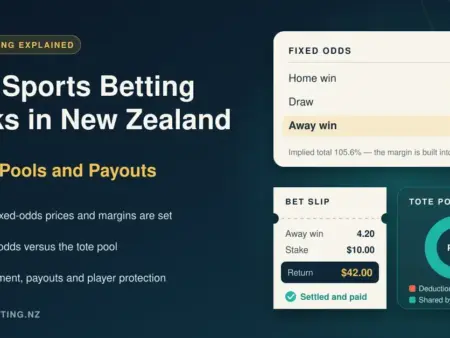
A strategy is a decision framework, not a shortcut to guaranteed money. Its job is to make your choices consistent: how big your stake is, which markets you bet, what evidence you require before placing a wager, and when you walk away. The mathematical reality behind every strategy is the bookmaker margin (often called the “overround”), the built-in edge that makes the implied chances of all outcomes add up to more than 100%. Because of that margin, the long-run expectation for a typical bettor is negative, and a large majority of people who bet on sport lose money over time. A good strategy accepts this openly and focuses on discipline and risk control rather than on promises of easy wins.
Start with a bankroll and a staking plan
The first step is to ring-fence a bankroll: a fixed sum of money, entirely separate from rent, bills and savings, that you would be comfortable losing. From that bankroll you set a “unit” — a standard stake size, commonly 1–2% of the total. Sizing every bet in units rather than dollars keeps a single result from doing outsized damage and removes the temptation to bet bigger to “win it back”. Careful bankroll management is the part of a strategy that most reliably separates people who last from people who blow up in a weekend.
Common staking methods
There is no single “correct” staking plan; the right one depends on your experience and how much variance you can tolerate. Flat staking is the simplest and safest starting point. Proportional and Kelly-style plans adjust stake size to the perceived edge, but they demand accurate probability estimates and can swing a bankroll sharply if those estimates are wrong, which is why many experienced bettors use only a fraction of the Kelly figure.
Staking Methods Compared
| Method | How it works | Risk level | Best suited to |
|---|---|---|---|
| Flat staking | The same fixed unit on every bet regardless of confidence | Low | Beginners and steady, long-run play |
| Percentage (proportional) | A set percentage of the current bankroll each time, so stakes rise and fall with it | Low–medium | Bettors who want stakes to track their bankroll |
| Fractional Kelly | A fraction (e.g. a quarter or half) of the Kelly-recommended stake based on your estimated edge | Medium–high | Experienced bettors confident in their probability estimates |
| Stop-loss rule | A pre-set limit that pauses all betting if the bankroll falls by a chosen amount | Safety control | Everyone, as a guard against chasing losses |
Surviving losing runs
Losing streaks are a statistical certainty, not a sign the plan has failed. A sensible strategy sets a stop-loss — a point (for example, a set percentage of the bankroll in a month) at which you stop and review rather than chase. Chasing losses with bigger bets is one of the clearest warning signs of gambling harm. If betting stops feeling optional, New Zealand punters can set deposit limits, take a time-out, or self-exclude from betting sites entirely.
Odds, implied probability and the bookmaker margin
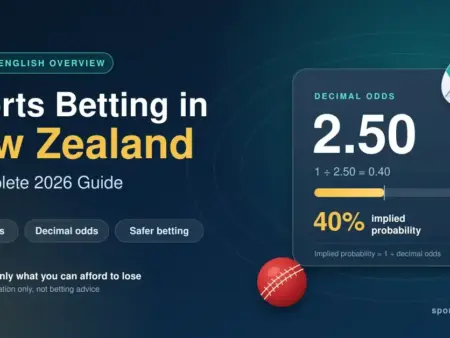
New Zealand betting is quoted in decimal odds, which show the total return per $1 staked (including your stake). Every decimal price carries an implied probability — the chance the market is assigning to that outcome — which you find with the formula (1 ÷ decimal odds) × 100. Odds of 2.00 imply a 50% chance. Because the bookmaker adds a margin, the implied probabilities of all outcomes in a market sum to more than 100%; that surplus is the overround, and it is the cost you pay to bet. Understanding how decimal odds work is the foundation everything else is built on.
Converting decimal odds to probability
- 1.50 odds → 66.7% implied probability
- 2.00 odds → 50% implied probability
- 2.50 odds → 40% implied probability
- 4.00 odds → 25% implied probability
- 10.00 odds → 10% implied probability
Finding value and thinking in expected value
“Value” describes a bet where your own estimate of an outcome’s probability is higher than the probability implied by the price. If you genuinely believe a team has a 60% chance but the odds imply only 50%, that is a positive-expected-value (+EV) situation. The catch is that your estimate has to be more accurate than the market’s, and the market already reflects a great deal of information. Value betting is a concept for disciplined analysis, not a guarantee — our guide to value betting in NZ explains how the idea works and where its limits lie. The honest takeaway is that consistently identifying value is difficult, and it is the exception rather than the rule.
Specialise in a market you understand
No one can follow every league closely. Narrowing your focus — to, say, the NPC, Super Rugby Pacific, the ANZ Premiership or a single NRL competition — lets you build genuine knowledge of team depth, travel schedules, weather and tactical match-ups. Lower-profile markets attract less betting volume, so their prices are sometimes less finely tuned than heavily traded markets such as the English Premier League or the NBA. Specialising will not manufacture an edge on its own, but it makes your analysis more informed and your decisions more consistent. Be especially wary of “hometown bias”: when the All Blacks or the Warriors play, patriotic money can shorten a price well past the point of any value.
Keep records and review your results
You cannot improve what you do not measure. Log every bet: date, sport, market, the odds you took, the stake, and the result. Reviewing that log periodically reveals where you actually make and lose money — you might find you break even on one code but leak steadily on multi-bets. Honest record-keeping also exposes emotional patterns, such as bigger stakes late at night or after a loss. If you want to take this analytical approach further, the broader field of sports analytics offers structured ways to turn match data into repeatable insights.
Closing line value, ROI and yield
Two figures are worth tracking beyond simple win rate. Return on investment (ROI) measures profit against the total amount staked. Closing line value (CLV) compares the odds you took with the price at kick-off: if you consistently beat the closing line, it is a sign your judgement is tracking the market well, even before the results settle. Both are long-run measures — a handful of bets tells you almost nothing.
The 2026 New Zealand rules that shape your strategy
Strategy has to operate inside the law, and New Zealand’s framework changed significantly in 2025–26. Since the Racing Industry Amendment Act took effect on 28 June 2025, TAB NZ is the only operator legally permitted to take online sports and racing bets from people in New Zealand, and offshore bookmakers are prohibited from targeting the NZ market. Separately, the Online Casino Gambling Act 2026 came into force on 1 May 2026, creating the country’s first licensing regime for online casinos; the Department of Internal Affairs (DIA) is allocating up to 15 licences through expressions of interest and an auction, but that regime is not expected to be fully operational until 2027 and it concerns online casino gambling, not sports or racing. In practical terms, a compliant sports-betting strategy in 2026 runs through TAB NZ. If you want the detail, see our overview of New Zealand’s betting laws.
Discipline, bias and staying in control
The hardest part of any plan is following it when emotions run high. Two well-documented biases trip up bettors: the Gambler’s Fallacy (believing an outcome is “due” after a run) and recency bias (over-weighting the last result you saw). A strategy exists precisely to override those instincts with pre-agreed rules — if the plan caps a stake at 2% of the bankroll, that limit holds even when a result feels “certain”. Judge yourself on the quality of each decision, not on whether a single bet won. Setting deposit limits, session timers and reality checks, covered in our guide to responsible gambling tools, is part of a mature approach rather than an afterthought.
Responsible Gambling
This article is general information about how betting works in New Zealand. It is not betting advice and it does not encourage you to gamble. Betting carries real financial risk, the odds always favour the operator over time, and no system or strategy can guarantee a profit. Only wager money you can afford to lose, and never bet to recover losses or to solve financial problems. You must be 18 or over to bet in New Zealand. If gambling is causing you or someone you know harm, free and confidential help is available 24/7 from the Gambling Helpline on 0800 654 655 (or text 8006), and you can call or text 1737 to talk with a trained counsellor at any time.
Sources
Frequently Asked Questions (FAQ)
Where should a beginner start when building a betting strategy?
Begin by ring-fencing a bankroll you can afford to lose, then set a fixed unit size of around 1–2% of it and stick to one sport you follow closely. Getting the money management and discipline right matters far more at the start than finding clever bets.
Is online sports betting legal in New Zealand in 2026?
Yes, but only through TAB NZ. Since 28 June 2025 TAB NZ has been the sole operator legally allowed to take online sports and racing bets from people in New Zealand, and offshore operators are prohibited from targeting the local market.
How do I work out the implied probability of a price?
Divide 1 by the decimal odds and multiply by 100. For example, 1 ÷ 2.50 × 100 = 40%. Because bookmakers add a margin, the implied probabilities of all outcomes in a market add up to more than 100%.
What is a “unit” and why use one?
A unit is a fixed standard stake, usually a set percentage of your bankroll. Betting in consistent units keeps any single result from causing outsized damage and makes it easier to track performance objectively rather than emotionally.
Can a betting strategy guarantee that I win money?
No. The bookmaker margin means the long-run expectation for most bettors is negative, and the majority of punters lose over time. A strategy improves discipline and risk control; it cannot remove the built-in house edge or guarantee a profit.