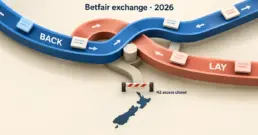

Betfair is the world’s largest online betting exchange — a platform where customers bet against each other rather than against a bookmaker. It built a long history in the United Kingdom and Australia, but for people in New Zealand the picture changed sharply in 2025. This guide explains what Betfair is, how a betting exchange actually works, who owns it, and why it no longer accepts sports and racing bets from anyone located in New Zealand.
Quick Facts
| Product type | Online betting exchange (peer-to-peer wagering) |
|---|---|
| Global brand | Betfair — part of Flutter Entertainment |
| Founded | June 2000, United Kingdom (Andrew Black and Edward Wray) |
| Australian operator | Betfair Australia (betfair.com.au), owned by Crown Resorts |
| Australian licence | Betting Exchange Operator Licence, Northern Territory Racing Commission |
| Cost to bettors | Commission on net winnings (no built-in bookmaker margin) |
| NZ sports & racing betting | Not available — withdrawn from 23 July 2025 |
| Only legal NZ online operator | TAB NZ (sports and racing) |
What a Betting Exchange Actually Is
A traditional bookmaker (also called a sportsbook) sets the odds, takes your bet and keeps the difference if you lose. A betting exchange works differently: it is a marketplace that matches two customers who disagree about an outcome. One person wants to bet for a result and another is willing to bet against it. The exchange simply pairs them and takes a small cut of the winnings.
Because the prices come from other users rather than from a single operator’s pricing team, exchange odds can be sharper on popular events. The trade-off is that a bet is only struck if someone takes the other side — a concept called liquidity, meaning the amount of money available to match at a given price.
Backing and Laying Explained

Two terms sit at the heart of every exchange:
- Back — betting for something to happen (a horse to win, a team to win). This is the same as a normal bet with a bookmaker.
- Lay — betting against something happening. When you lay, you effectively act like the bookmaker: you accept someone else’s backing bet and pay out if that outcome wins.
Laying is what makes an exchange distinctive, and also what makes it riskier for newcomers. If you lay a selection, your potential loss (your liability) can be much larger than the amount you stand to win, because you are covering someone else’s winning bet.
Commission Instead of a Built-In Margin
A bookmaker builds a profit margin into its odds — sometimes called the overround — so the prices add up to more than 100% of the true chances. An exchange charges nothing in the price itself; instead it takes a commission on your net winnings in a market, historically in the region of around 5%, varying by country and market. If you understand how decimal odds translate into implied probability, you can see why exchange prices often look a little better than a bookmaker’s for the same event.
Betfair’s History and Ownership

Betfair was founded in the United Kingdom in June 2000 by Andrew Black and Edward Wray, who wanted to pair bettors directly rather than route every wager through a bookmaker. Black had a background in building trading software, and the exchange borrowed ideas from financial markets — matching buyers and sellers of a bet much as a stock exchange matches buyers and sellers of shares. The model was controversial with traditional bookmakers at first, but it grew into the largest exchange of its kind in the world. In 2016 Betfair merged with Paddy Power to create Flutter Entertainment, the global gambling group that now sits behind the Betfair brand internationally.
The Australian business has a separate ownership story, which matters when you look at who you would actually have been dealing with as a customer in this part of the world.
Betfair in Australia
Betfair’s Australian arm, operating at betfair.com.au, had its first bets matched in 2006 under a non-exclusive licence from the Tasmanian Gaming Commission, and later moved its licensing to the Northern Territory Racing Commission. It is the only licensed betting exchange in Australia and, unlike most Australian operators, it offers an exchange rather than fixed-odds bookmaking or tote betting.
Ownership sits with Crown Resorts, which took full control of Betfair Australia in 2014 and itself was later acquired by investment firm Blackstone. The Australian company runs the exchange under a business-to-business arrangement with the global Betfair platform. Australian point-of-consumption rules have also curtailed sign-up inducements, which is why exchanges and bookmakers there rarely advertise the kind of welcome bonuses seen in some other markets.
Why Betfair No Longer Takes New Zealand Sports and Racing Bets
This is the part that most affects Kiwi readers. New Zealand changed its gambling law in 2025. Under amendments carried by the Racing Industry Amendment Act 2025 — which received Royal Assent on 27 June 2025 and took effect from 28 June 2025 — it became unlawful for anyone other than TAB NZ to offer or promote online racing and sports betting to a person located in New Zealand. The rule applies to events held both inside and outside the country, and it is enforced by the Department of Internal Affairs (DIA), which can pursue penalties of up to NZ$5 million.
Betfair holds an Australian licence, not a New Zealand one. To comply with the new law, it told its New Zealand customers that it would stop offering racing and sports markets from 23 July 2025. In its notice, the company said it had to make the change “to comply with the Legislative Amendment.” Non-sporting markets, such as politics and entertainment, were reported to remain available where they are permitted, but the core racing and sports betting that Betfair was known for is no longer open to people in New Zealand.
The reasoning behind the law is straightforward: New Zealand wanted money wagered by Kiwis to flow back into local racing and sport rather than to offshore operators who paid nothing toward it. Extending TAB NZ’s existing exclusivity to online betting was the mechanism chosen to achieve that. The DIA has already issued cease-and-desist notices to offshore operators advertising to New Zealand audiences, signalling that the rule is being actively enforced rather than left on paper.
Betfair is far from alone here. The same law pushed every offshore bookmaker and exchange out of the NZ sports and racing market. For the wider picture, see our explainer on how New Zealand regulates offshore sportsbooks.
What Happened to New Zealand Betfair Accounts
If you held a Betfair account before the change, the practical effect was that racing and sports markets simply stopped being available to you from 23 July 2025. Reporting at the time indicated accounts were not necessarily closed outright, with some non-sporting markets still accessible where allowed, but the betting most customers used Betfair for was switched off.
Because account rules, balances and withdrawal processes are specific to each person’s situation and can change, the only reliable way to confirm the current status of an existing account or any remaining funds is to contact Betfair directly through its official channels. This guide cannot advise on individual accounts, and no third-party site should be trusted to “reactivate” NZ betting access — doing so would be unlawful for the operator and offers you no consumer protection.
What This Means for New Zealand Punters
In practical terms, online sports and racing betting is legal in New Zealand only through TAB NZ. TAB NZ offers both tote (pooled) betting and fixed odds across racing codes and sports; our guide to TAB NZ racing explains how those two formats differ. If you previously held a Betfair account, you would need to deal with Betfair directly about any remaining balance and the status of your account under the new rules.
It is worth separating two different law changes that are often confused. The TAB-only rule above covers sports and racing betting. Online casino gambling is handled under a separate law, the Online Casino Gambling Act 2026, which came into force on 1 May 2026 and is set to license up to 15 online casino operators, with licences expected later in 2026. That casino regime does not change anything about betting exchanges or sports and racing wagering, which remain TAB NZ’s exclusive domain. For broader context, our overview of sports betting in New Zealand ties the rules together.
Comparison
| Feature | Betting exchange (Betfair) | Traditional bookmaker | TAB NZ |
|---|---|---|---|
| Who you bet against | Other customers | The bookmaker | A tote pool or TAB’s fixed odds |
| Can you “lay” (bet against) an outcome? | Yes | No | No |
| How the operator earns | Commission on net winnings | Margin built into the odds | Margin / pool takeout |
| Legal for NZ online sports & racing? | No (offshore ban from 28 June 2025) | No (unless NZ-licensed — none are) | Yes — the sole legal operator |
| Best suited to | Experienced, price-focused punters | General punters | NZ punters wanting a legal option |
How a Betting Exchange Works in Practice

Although NZ users can no longer place sports and racing bets with Betfair, understanding the mechanics helps explain why exchanges attract experienced punters elsewhere. On a typical exchange screen each selection shows two sides:
- A back price and a lay price, often colour-coded (blue for back, pink for lay in Betfair’s long-standing layout).
- The larger figure in each box is the odds; the smaller figure is the amount currently available to be matched at that price.
You can accept the best price on offer, or set your own. If you ask for a bigger price than anyone is currently offering, your bet sits as unmatched until — and unless — someone takes the other side. This is why liquidity tends to build closer to an event: more customers are active, so more money is available to match.
Fees, Promotions and Common Misunderstandings
A few points are regularly misunderstood about exchanges:
- Commission is charged on winnings, not stakes. You pay a percentage of your net profit in a market, not on every bet you place.
- Exchanges rarely run bookmaker-style promotions. There are usually no money-back specials or bonus bets; the appeal is the price, not the offers.
- Better odds depend on liquidity. On a niche market with little money matched, the “sharper price” advantage can disappear.
- Laying carries real liability. Betting against an outcome can expose you to a loss much larger than your intended stake.
Who a Betting Exchange Suits
Betting exchanges are generally aimed at confident, price-focused punters who want to shop for value, back and lay the same market, or trade a position as odds move. They are a poor starting point for beginners, who are usually better served by a simpler fixed-odds product and by learning the fundamentals first. Either way, for anyone in New Zealand the only lawful route for online sports and racing betting is TAB NZ — the exchange model is simply not on the table here.
A Note on Responsible Gambling
This article is factual information only. It is not betting advice and it does not encourage you to gamble. Betting carries financial risk, and no system, strategy or market type changes the fact that the operator holds a long-term edge. If you choose to bet, use a licensed operator, set deposit and time limits in advance, and treat any losses as the cost of entertainment rather than a way to make money. Make use of responsible gambling tools such as limits and self-exclusion.
If gambling is causing you or someone you know harm, free and confidential help is available in New Zealand. Contact the Gambling Helpline Aotearoa any time on 0800 654 655, or free text 8006, and see Safer Gambling Aotearoa for more support. You must be 18 or over to bet on sports or racing in New Zealand.
Sources
- Department of Internal Affairs — new rules on offshore betting
- Simpson Grierson — “Scratched: New Zealand bans offshore betting”
- The Straight — Betfair to stop racing and sports markets in New Zealand
- Thomson Reuters NZ — Online Casino Gambling Act and the race/sports betting ban
- SBC News — Betfair’s B2B model and Crown Resorts ownership in Australasia
- Betfair Australia — official site
Frequently Asked Questions (FAQ)
Can I bet on sport or racing with Betfair in New Zealand?
No. Betfair stopped offering racing and sports betting to New Zealand customers from 23 July 2025 in order to comply with New Zealand’s offshore betting ban. The only operator legally allowed to take online sports and racing bets from people in New Zealand is TAB NZ.
What is the difference between backing and laying?
Backing means betting for an outcome to happen, the same as a normal bet. Laying means betting against it — you accept someone else’s backing bet and pay out if that outcome wins, effectively taking the bookmaker’s role. Laying can expose you to a loss larger than your stake.
Is Betfair legal in New Zealand?
Betfair is a legally licensed operator in Australia, but it is not licensed in New Zealand and may not offer online sports or racing betting to people located here. Since the 2025 law change, only TAB NZ can lawfully do that.
Who is the only legal online sports and racing operator in New Zealand?
TAB NZ. Under amendments that took effect on 28 June 2025, it is unlawful for any operator other than TAB NZ to offer or promote online racing and sports betting to anyone in New Zealand, and the Department of Internal Affairs enforces the rule.
How does a betting exchange make money if it does not set the odds?
Instead of building a margin into the price like a bookmaker, an exchange charges a commission on your net winnings in each market — historically around 5%, depending on the country and market. You pay it only on profit, not on every stake.