Online sports and racing betting is legal in New Zealand, but only when you place your bets with the country’s single authorised operator. Since 28 June 2025, amendments to the Racing Industry Act 2020 have given TAB NZ — and its Betcha brand — the exclusive right to offer online sports and racing wagering to anyone located in New Zealand. That change closed the long-standing “grey market” that let overseas bookmakers accept bets from Kiwis. This guide explains what the law actually says in 2026, why offshore sites are now off-limits, how the separate online casino regime differs, and the consumer-protection rules that come with betting through a licensed operator.
Key Points
- TAB NZ (and its Betcha brand) is the only operator legally allowed to offer online sports and racing betting to people in New Zealand.
- The offshore “grey market” for sports and racing betting closed on 28 June 2025 under amendments to the Racing Industry Act 2020.
- You must be 18 or over and pass identity verification before you can deposit.
- Online casino games are governed by a separate law, the Online Casino Gambling Act 2026, with a capped 15-licence system.
- Credit cards and buy-now-pay-later are banned for regulated online gambling, and recreational winnings are generally tax-free.
The short answer: legal, but only through TAB NZ

If you are physically in New Zealand and aged 18 or over, you can lawfully bet on sport and racing online — provided you do so with TAB NZ or its Betcha brand. Every other online bookmaker, including well-known international brands, is now operating unlawfully if it takes a bet from someone in New Zealand. The reform was driven by the roughly NZ$180–200 million that TAB NZ estimated was being wagered offshore each year, money that previously left the country instead of funding local racing and sport. For a general primer on how sports betting works as a concept, the basics are the same everywhere; what changed in New Zealand is who is allowed to offer it.
Quick Facts
| Is online sports betting legal? | Yes — only through TAB NZ (including Betcha) |
|---|---|
| Minimum age | 18 years |
| Offshore betting | Unlawful to accept NZ bets since 28 June 2025 |
| Tax on winnings | Recreational winnings generally not taxed |
| Regulator | Department of Internal Affairs (DIA) |
| Free support | Gambling Helpline 0800 654 655 |
The legal framework behind the 2026 rules
Two main pieces of legislation shape the current position, with a third governing online casino games. The Gambling Act 2003 is the core law for most gambling in New Zealand and prohibits “remote interactive gambling” unless it is specifically authorised. The Racing Industry Act 2020, as amended in 2025, extends TAB NZ’s wagering monopoly from physical outlets into the online space. Because the amendments apply to bets taken “from a person located in New Zealand”, the rules reach overseas companies that target New Zealand residents, not just domestic ones.
The role of the Department of Internal Affairs
The Department of Internal Affairs (DIA) is the government regulator responsible for enforcing gambling law. It monitors compliance, warns consumers about unlicensed operators, and can pursue companies that continue to accept New Zealand bets. If you want the detail on enforcement, our overview of how New Zealand regulates offshore sportsbooks goes further.
| Legislation | What it does | Effect on online betting |
|---|---|---|
| Gambling Act 2003 | Core law for most gambling | Bans unauthorised remote interactive gambling |
| Racing Industry Act 2020 (amended 2025) | Sets TAB NZ’s wagering monopoly | Grants exclusive online sports and racing betting rights from 28 June 2025 |
| Online Casino Gambling Act 2026 | Regulates online casino games | Separate licensing regime; does not cover sports or racing |
TAB NZ and the partnership with Entain
TAB NZ is the sole authorised provider of online sports and racing wagering. It runs its wagering and media operations under a 25-year strategic partnership with the international operator Entain, which began on 1 June 2023. The arrangement was designed to modernise the TAB’s technology and betting markets while keeping profits within the New Zealand racing and sporting system. You can read more about the brand on our TAB NZ page.
What the Entain deal involves
Under the partnership, Entain manages TAB NZ’s wagering and Trackside media businesses and shares revenue with the local industry. It made a substantial upfront payment when the deal was approved, plus a further NZ$100 million tied to the implementation of the “legislative net” that removed offshore competition, along with guaranteed minimum annual payments in the early years. In practical terms for punters, the result is a wider range of markets — from All Blacks tests and Super Rugby Pacific to the NRL and international esports — together with account funds and personal data that sit under New Zealand consumer and privacy law.
Funding racing and sport
The clearest public benefit of the model is where the money goes. Rather than profits leaving the country, TAB NZ funds the racing industry and distributes money to sporting codes through Sport NZ. Supporters of the reform point to the racing sector’s wider economic footprint — around 13,500 jobs — as a reason to keep wagering revenue onshore.
- Racing viability: stable funding for clubs and events across the country.
- Sport funding: a share of returns flows to national and grassroots sport.
- Local integrity: TAB markets fall under New Zealand integrity oversight.
- Revenue retention: profits stay in New Zealand rather than going offshore.
Why offshore betting sites are now off-limits

Importantly, the law does not rely on internet service providers geo-blocking offshore websites. Lawmakers deliberately stopped short of website blocking, judging it impractical given how easily URLs change. The “legislative net” is therefore a legal prohibition on operators, backed by advertising and enforcement powers — not a technical firewall around the country.
The main reason for restricting online sports and racing betting to a domestic operator was consumer protection. When a bet is placed with an unlicensed overseas bookmaker, the customer generally has no legal recourse in New Zealand if the site refuses to pay out, freezes an account, or mishandles personal information. Offshore operators also do not contribute to the Problem Gambling Levy that funds support services here. The table below summarises the practical differences.
| Feature | Authorised (TAB NZ / Betcha) | Offshore (unlicensed) |
|---|---|---|
| Legal status | Lawful | Unlawful to accept NZ bets since 28 June 2025 |
| Consumer recourse | Protected under NZ law | Little or no recourse |
| Funding | Supports NZ racing and sport | Profits leave the country |
| Harm-minimisation tools | Required | Often minimal or absent |
| Data protection | Governed by the NZ Privacy Act | Variable |
The 2026 online casino regime is separate
It is important not to confuse sports betting with online casino gaming. While the sports and racing monopoly sits with TAB NZ, online casino games such as slots and table games are regulated under a different law: the Online Casino Gambling Act 2026, which came into force on 1 May 2026. Under it, the DIA will issue up to 15 brand-specific licences to commercial operators. Crucially, those licensees are not permitted to offer betting on real-world sport or racing — that remains exclusive to TAB NZ.
Licensing timeline
The DIA is allocating the capped licences through a staged process across the second half of 2026: a paid expressions-of-interest round over July and August, a competitive auction in September, and full licence applications from the successful bidders. The regulated online casino market is scheduled to open on 1 December 2026, after which unlicensed operators are expected to exit the New Zealand market during 2027.
- Law in force: 1 May 2026.
- Auction: September 2026.
- Market opens: 1 December 2026.
- Licence cap: up to 15 brand-specific licences, with no single entity controlling more than three.
- Scope: online casino games only — not sport or racing.
Safer-betting and payment rules

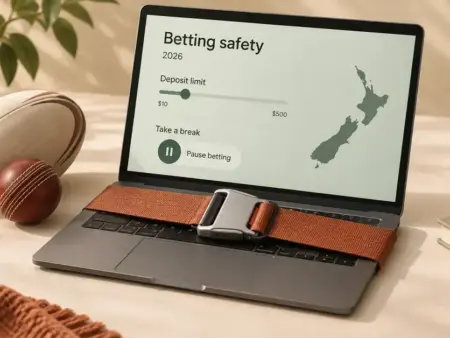
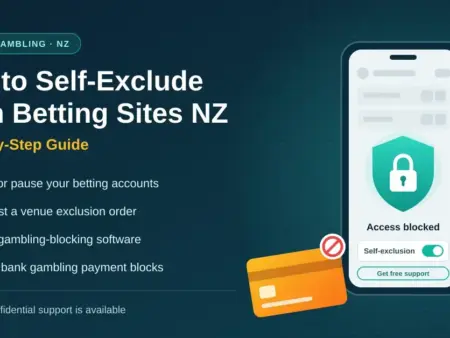
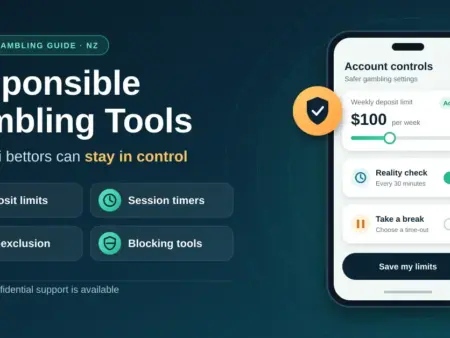
New Zealand’s regulated online gambling rules include some of the stronger harm-minimisation requirements found anywhere. Authorised platforms must verify a customer’s age and identity before any deposit, and must offer tools to set daily, weekly or monthly limits on deposits, spending and time played, prompted when an account is created and reinforced afterwards. Design features that push continuous play, such as autoplay, are prohibited. If you want to step away, our guide on how to self-exclude from betting sites and our overview of responsible gambling tools explain the options.
Payment rules have tightened too. Credit cards and “buy now, pay later” facilities are banned for regulated online gambling, leaving debit cards and direct bank transfers as the main funding methods. Under the online casino regime, customers are limited to one account and one deposit method per platform, with a 24-hour delay before deposit-method changes take effect.
- Deposit limits: caps on what you can transfer in over a set period.
- Spending and time limits: prompted at sign-up and reviewed regularly.
- Age verification: mandatory R18 identity checks before depositing.
- Self-exclusion: the ability to block your own access temporarily or long term.
- Payment restrictions: no credit card or buy-now-pay-later deposits.
Advertising rules and penalties
Gambling advertising is tightly controlled. Promoting an unlicensed or offshore gambling operator is an offence under section 16 of the Gambling Act 2003, carrying fines of up to $10,000 per breach, and the DIA has already fined social-media influencers for promoting offshore casinos. For licensed online casino operators, advertising is heavily restricted: ads cannot appear on the front pages of print publications or on public transport, are banned during live events and in the 30-minute windows before and after them, and must not encourage excessive or impulsive gambling or create a false sense of urgency.
| Advertising rule | Detail |
|---|---|
| Promoting offshore operators | An offence under s16 Gambling Act 2003; up to $10,000 per breach |
| Placement limits | No print front pages or public transport; none during live events or the 30 minutes either side |
| Content | Must not encourage excessive or impulsive play or create urgency |
| Enforcement powers | DIA can issue take-down notices and impose pecuniary penalties of up to NZ$5 million for unlawful advertising |
Tax, duty and the problem gambling levy
The system is designed so the industry contributes to the public purse and to harm services. Online casino operators pay an online gambling duty of 12% of gross gambling revenue, scheduled to rise to 16% on 1 January 2027, and a portion of that duty is ring-fenced for community causes.
Funding harm-minimisation
A dedicated Problem Gambling Levy of 1.24% helps fund the national strategy to prevent and minimise gambling harm, so that the cost of treatment and support falls on the industry rather than the general taxpayer. For recreational punters, there is good news on personal tax: casual betting winnings are not treated as taxable income in New Zealand.
| Fiscal element | Rate | Recipient |
|---|---|---|
| Online gambling duty | 12% (16% from 1 Jan 2027) | NZ Government |
| GST | 15% | NZ Government |
| Problem Gambling Levy | 1.24% | Harm-prevention and support services |
| Community ring-fence | 4% of online gambling duty | NZ community causes |
Minimum age and identity checks
The minimum age for all forms of online gambling in New Zealand — including TAB betting and the new licensed casinos — is 18. The reforms also tighten “know your customer” (KYC) obligations to keep minors out and to guard against money laundering. For a deeper look at the age framework, see our guide to sports betting age limits in New Zealand.
Verification at sign-up
Authorised platforms must verify a customer’s age and identity before betting begins, and provisions relating to gambling on behalf of under-18s come into force during 2026.
- Identity check: valid New Zealand ID is required to open an account.
- One account rule: operators limit customers to a single account per platform.
- AML monitoring: platforms must report suspicious transactions.
Record-keeping and dispute resolution

A practical benefit of the authorised system is accountability. Bets placed with TAB NZ are recorded, and customers can access their betting history and withdraw remaining funds without undue delay. If a dispute arises — for example, over how a bet was settled — you can raise a formal complaint with the operator, and the DIA provides a pathway if you are not satisfied with the outcome. Offshore “grey market” sites offer no equivalent protection. New arrivals to wagering may also find our explainer on how sports betting works in New Zealand a useful starting point.
Responsible Gambling Disclaimer
This article is general information about New Zealand law and is not legal, financial or gambling advice, and it does not encourage anyone to gamble. Betting carries a real risk of financial loss and can cause harm. You must be 18 or over to bet, and only funds you can afford to lose should ever be wagered. If gambling is affecting you or someone you know, free and confidential help is available in New Zealand from the Gambling Helpline on 0800 654 655, 24 hours a day. Information about the law and licensed operators is published by the Department of Internal Affairs.
Reference sources
- Department of Internal Affairs — Law changes for online racing and sports betting
- Department of Internal Affairs — Online Gambling for Providers
- iGaming Business — NZ racing bill amendment enforced, TAB monopoly extended online
- Simpson Grierson — Scratched: New Zealand bans offshore betting
- Russell McVeagh — Online Casino Gambling Bill passes its final reading
- Entain — Strategic partnership with TAB New Zealand receives Government approval
- Department of Internal Affairs — Online Gambling FAQs
- Entain — New Zealand establishes legislative net for racing and sports betting
- TAB NZ — Legislative change set to increase funding for racing and sport
- Simpson Grierson — House Rules: New Zealand’s new online casino regime
- Inland Revenue — Gambling and lottery duties
- NZ Herald — NZ bans offshore betting, TAB gains monopoly with new law
Frequently Asked Questions (FAQ)
Is online sports betting legal in New Zealand in 2026?
Yes. Online sports and racing betting is legal, but only through TAB NZ and its Betcha brand. Placing bets with an offshore bookmaker is no longer lawful, because those operators are barred from accepting bets from people located in New Zealand.
What is the minimum age to bet on sport online in New Zealand?
You must be at least 18 years old. Authorised platforms require age and identity verification before you can deposit or place a bet.
Can I still use an old offshore betting account?
No. Offshore operators were required to stop taking bets from people in New Zealand from 28 June 2025. It is sensible to close any such accounts and withdraw remaining funds, as you have little consumer protection if a problem arises.
Are winnings from TAB NZ taxable?
Generally, winnings from recreational sports betting are not treated as taxable income for New Zealand residents. If betting is your business or income source, you should seek professional tax advice about your own situation.
How can I check whether a betting site is legal in New Zealand?
Legal online sports and racing betting is offered only by TAB NZ, including its Betcha brand. The Department of Internal Affairs publishes information on the law and, for the new online casino regime, on licensed operators, so its website is the authoritative place to check.
Are the new online casino licences the same as sports betting?
No. The up to 15 online casino licences issued under the Online Casino Gambling Act 2026 cover casino games such as slots and table games only. Those licence holders cannot offer bets on real sports or racing, which remain exclusive to TAB NZ.