Cryptocurrency casinos such as CoinCasino let players deposit, wager and withdraw using digital assets like Bitcoin, Ethereum or stablecoins instead of New Zealand dollars. This guide explains, in plain terms, what these platforms are, how blockchain-based “provably fair” gaming actually works, where they now sit under New Zealand law after the 2026 licensing reforms, and how to think about the risks. It is written to inform rather than to recommend: crypto casinos carry the same house edge as any other gambling product, and nothing here should be read as encouragement to play or as financial advice.
Key Facts
| Brand | CoinCasino — online crypto casino and sportsbook |
|---|---|
| Licence | Anjouan (Comoros) — not a New Zealand licence |
| Payment | Cryptocurrency (Bitcoin, Ethereum, stablecoins and others) |
| Typical payout speed | Minutes to hours after network confirmation |
| NZ regulatory status | Online Casino Gambling Act 2026 requires a DIA licence to serve NZ players |
| Age requirement | 18+ |
| Key risks | House edge, coin price volatility, irreversible transfers, no bank insurance |
What CoinCasino and crypto casinos are
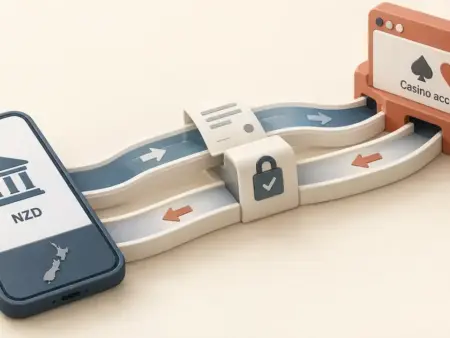
A crypto casino is an online gambling site that settles transactions in cryptocurrency rather than through banks or card processors. CoinCasino is one such brand; it advertises a large game library and support for many different coins, and it operates under a licence issued by Anjouan (part of the Comoros) rather than a New Zealand or European licence. “Cryptocurrency” simply means digital money recorded on a blockchain — a shared public ledger — instead of by a single bank.
The practical differences from a traditional online casino are mostly about payments and verification. Because transfers move directly between digital wallets, settlement can be faster and card-processing fees are replaced by blockchain “network fees” (sometimes called gas). None of this changes the underlying maths of the games themselves.
Traditional online casino vs crypto casino
| Feature | Traditional online casino | Crypto casino (e.g. CoinCasino) |
|---|---|---|
| Payment method | Cards, bank transfer, e-wallets | Bitcoin, Ethereum, stablecoins and other coins |
| Payout speed | Often 1–5 business days | Minutes to hours, once the network confirms |
| Fees | Processor or currency-conversion fees | Blockchain network fees |
| Consumer protection | Depends on the licence held | Depends on the licence; crypto is not bank-insured |
| Price stability | Balance held in fiat currency | Balance can rise or fall with the coin’s price |
How “provably fair” gaming works
Many crypto casinos advertise “provably fair” games. This is a cryptographic method that lets you check, after a round, that the result was not altered once your bet was placed. The site publishes a hashed (scrambled) version of its secret “server seed” before play, you contribute your own “client seed”, and the two are combined to produce the outcome. Afterwards you can reveal the server seed and confirm it matches the earlier hash.
It is important to be clear about what this does and does not do. Provably fair verification confirms a result was not tampered with; it does not remove the house edge, improve your odds, or make a game more likely to pay out. Every casino game is still designed to return less than it takes in over time.
- Server seed: the casino publishes a hashed version before the round begins.
- Client seed: you provide your own value that feeds into the result.
- Verification: a built-in or third-party tool checks the outcome against the hash.
- Public record: transactions are recorded on the blockchain and cannot be edited.
The legal position for New Zealand players in 2026
New Zealand’s rules changed substantially in 2026. The Online Casino Gambling Act 2026 came into force on 1 May 2026, with detailed regulations following on 3 July 2026. Administered by the Department of Internal Affairs (DIA), it creates New Zealand’s first licensing regime for online casino gambling, with up to 15 licences awarded through a competitive process and the regulated market expected to open around December 2026. Our overview of the sports betting laws in New Zealand covers the broader framework, and you can read background on the sector at Wikipedia.
Two points matter most for anyone considering a site like CoinCasino. First, the regime has extraterritorial reach: any operator enabling a New Zealand-based person to gamble online needs a New Zealand licence, regardless of where the company is based. An offshore Anjouan-licensed brand is therefore only compliant with the new regime if it obtains an NZ licence. Second, advertising, sponsorship, celebrity endorsement and affiliate marketing for these operators are restricted. For more on how offshore sites are treated, see our guide to how New Zealand regulates offshore operators.
- Licensing: operators serving NZ players require a DIA licence under the 2026 Act.
- Tax on winnings: recreational gambling winnings are generally tax-free in NZ; professional gamblers can be taxed, and disposing of cryptocurrency may have separate tax consequences — check current IRD guidance.
- Verification: licensed and reputable operators still run “Know Your Customer” (KYC) identity checks, often triggered at withdrawal.
- No bank protection: funds held in crypto are not covered by any NZ banking guarantee.
Common licence jurisdictions
| Jurisdiction | Notes | Relevance to NZ players |
|---|---|---|
| New Zealand (DIA) | New regime under the 2026 Act | The only NZ-recognised licence for the local market |
| Malta (MGA) | Well-established European regulator | Strong consumer-protection reputation |
| Curacao | Common for crypto casinos | Widely used; lighter oversight than the MGA |
| Anjouan (Comoros) | Licence held by CoinCasino | Not a New Zealand licence |
Cryptocurrencies, wallets and price volatility
To use a crypto casino you first need a wallet — software or a device that stores your coins and lets you send and receive them. A key risk unique to crypto gambling is the “double” exposure: the game outcome plus the changing value of the coin. If you win an amount of Bitcoin and its price falls before you convert to dollars, your real-world value can drop even though you “won”. Some players hold winnings in stablecoins (coins such as USDT or USDC that aim to track the US dollar) to reduce that swing, though stablecoins carry their own risks.
- Track the NZD value: view balances in dollar terms so you understand real profit or loss.
- Understand volatility: coin prices can move sharply in either direction.
- Irreversible transfers: sending crypto to a wrong address usually means the funds are lost for good.
Security and protecting your funds
Crypto puts more responsibility on the individual than a bank account does, because there is often no “reset password and call support” safety net. Sensible precautions apply whether or not you gamble. For a wider view, see our guide to staying safe when betting online.
- Two-factor authentication: use an app-based authenticator rather than SMS, which is vulnerable to SIM-swapping.
- Keep most funds offline: hardware wallets (“cold storage”) reduce exposure to hacks.
- Check the address and URL: verify wallet addresses and that the site is genuine before sending anything.
- Use unique credentials: a dedicated email and a strong, unique password managed in a password manager.
Games you will find at crypto casinos
Alongside the slots, live-dealer tables and roulette found at any online casino, crypto platforms popularised a handful of fast, simple “originals”:
- Crash: a multiplier rises from 1.0x and you try to cash out before it “crashes”.
- Dice: you set a target and win probability, with the payout adjusting accordingly.
- Plinko: a ball drops through pegs into slots with different multipliers.
- Mines: you reveal tiles for rising multipliers while avoiding hidden “bombs”.
These games are built for rapid, repeated betting. That speed can make it easy to stake more than intended, so published return-to-player (RTP) figures should be read from each game’s own rules rather than assumed.
Bonuses and wagering requirements
Crypto casinos often advertise large match bonuses, cashback and free spins. The headline figure is rarely the whole story: a “wagering requirement” sets how many times a bonus must be staked before winnings can be withdrawn. Requirements commonly range from around 20x to 50x, and the higher the multiplier, the more play is needed to unlock any value. Always read the full terms — game weightings, maximum bets and expiry dates — before opting in, and treat any bonus as marketing rather than free money.
Playing responsibly with fast payouts
The speed and relative anonymity of crypto can remove the natural “friction” — declined cards or multi-day withdrawals — that helps people pause. That makes deliberate limits more important, not less. Setting loss limits in dollar terms, using session reminders, and taking breaks all help. If gambling stops being fun or affordable, self-exclusion tools block access for a set period; our step-by-step guide explains how to self-exclude from betting sites, and there is more in our overview of responsible gambling tools for NZ bettors.
Key Points
- Crypto casinos settle in digital coins; the games still carry a house edge.
- “Provably fair” verifies a result was not altered — it does not improve your odds.
- The Online Casino Gambling Act 2026 requires operators serving NZ players to hold a DIA licence, wherever they are based.
- CoinCasino holds an Anjouan licence, not a New Zealand licence.
- Coin price volatility can change the real value of a win before you cash out.
- Crypto transfers are irreversible and funds are not bank-insured — secure your wallet and set limits.
Other crypto-friendly casinos seen by New Zealanders are covered in our guides to Lucky Block, FastSlots and FatFruit. All are licensed offshore, not in New Zealand.
Responsible Gambling Notice
This article is for general information only. It does not encourage gambling and is not financial, legal or tax advice. Gambling always carries a risk of loss, the house holds a mathematical edge, and cryptocurrency adds price volatility on top of that risk. You must be 18 or over to gamble in New Zealand. Only ever stake money you can afford to lose. If gambling is causing harm to you or someone you know, free and confidential help is available:
- Gambling Helpline — call 0800 654 655 or text 8006, available 24/7.
- PGF Services — call 0800 664 262 for free counselling and support.
- Safer Gambling Aotearoa — information, self-help tools and services near you.
- Department of Internal Affairs — the regulator for gambling in New Zealand.
Sources
Frequently Asked Questions
Is CoinCasino legal for New Zealand players?
New Zealand’s Online Casino Gambling Act 2026 requires any operator that lets a New Zealand-based person gamble online to hold a licence from the Department of Internal Affairs, no matter where the company is based. CoinCasino operates under an Anjouan (Comoros) licence, not a New Zealand one, so its position under the new regime depends on whether it obtains a local licence. The 2026 rules also restrict advertising and affiliate promotion of such operators.
Does “provably fair” mean I am more likely to win?
No. Provably fair is a cryptographic tool that lets you confirm a result was not altered after your bet. It does not change the house edge or improve your odds. Casino games are still designed to pay out less than they take in over time.
Are crypto gambling winnings taxed in New Zealand?
Recreational gambling winnings are generally tax-free in New Zealand, but a person who gambles as a professional business can be taxed on that income. Separately, buying and selling cryptocurrency can itself have tax consequences because the IRD treats crypto as property. Check current Inland Revenue guidance or a tax professional for your situation.
What happens if I send crypto to the wrong address?
Cryptocurrency transfers are irreversible. If you send funds to an incorrect address there is usually no way to recover them, which is why you should always double-check the address before confirming any transaction.
How can I keep my crypto and my play safe?
Use app-based two-factor authentication rather than SMS, keep most of your funds in offline “cold” storage, verify site URLs and wallet addresses, and use a unique password. To manage your gambling, set dollar-based limits, take breaks, and use self-exclusion tools if you need to step away.